Yoga for Functional Strength: Kettlebell + Flow Hybrid
Build real-life strength with Yoga for Functional Strength: Kettlebell + Flow Hybrid.
HEALTH TIPS
1/19/20266 min read
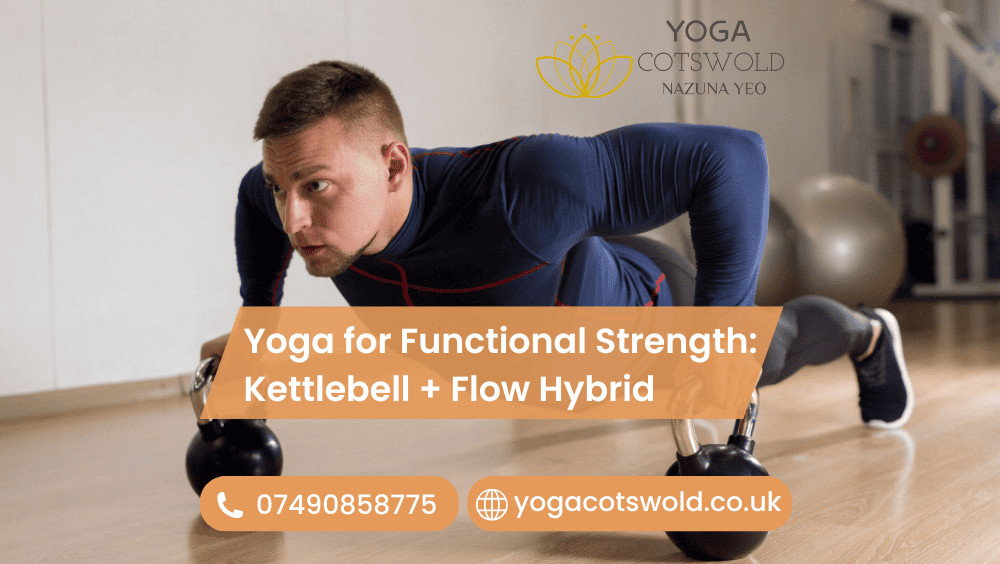
When we wake up in the morning, few of us think: “I want a bigger squat.” We think, ‘I want my back to feel better,’ or ‘I want to be able to carry things without feeling wobbly,’ or we say, ‘I’m interested in strength that actually shows up in real life.’ That’s the essence of functional strength: the variety that helps you move better throughout your day, extend great posture and have a sense of agency — whether while hiking around the Cotswolds, hoisting up that suitcase to the overhead bin, digging in your garden or just standing up from the floor with ease.
Yoga already offers plenty: balance, mobility, coordination, and calm. Still, many people reach a point where they want more “load”—something that teaches the body to produce strength under real-world demand. That’s exactly why a kettlebell + flow hybrid works so well. It combines the clarity and body awareness of yoga with the efficient power-building of kettlebell training. As a result, you build strength that’s not only visible, but also useful.
In a nutshell, I’m here to tell you how yoga for functional strength works, why kettlebells are such a smart partner to flow practice and how to structure a session that feels athletic and mindful — without turning your yoga mat into a battlefield.
What Is Functional Strength?
Functional strength, then, is your ability to move well and perform life’s tasks without compensating or injuring yourself. It's not just muscle, in other words— it’s control.
For example, functional strength looks like:
lifting something from the floor while keeping your spine long
carrying shopping bags without your shoulders creeping up to your ears
stepping up a hill with stable knees and strong hips
twisting without yanking your lower back
stabilising your body while you reach, pull, or change direction
Yoga supports this because it trains full-body integration. You learn how feet, hips, ribs, shoulders and breath relate. It also develops strength through holds and transitions (Chaturanga, anyone?) Just think about how much stability it takes to hold Chair Pose, Plank or Warrior III. That stability is gold.
However, yoga often uses bodyweight only. And while that’s brilliant, adding an external load can accelerate strength gains—especially for the hips, back, grip, and core. That’s where the kettlebell comes in. Get details on Yoga Teacher in Swindon Village.
Why Kettlebells Fit Yoga Better Than You’d Expect
A kettlebell looks simple, yet it’s a clever tool. Because the weight sits slightly away from your hand, it challenges your stability instantly. Consequently, you train your core and posture without overthinking it.
Here’s what kettlebells bring to a yoga-based strength approach:
Posterior chain strength (glutes, hamstrings, back): essential for posture and back support
Hip hinge power: the foundation for safe lifting and athletic movement
Grip strength: often ignored, yet crucial for daily function and joint health
Core stability: focusing on anti-rotation control (resisting rotations while load shifts)
Time saving workouts: you can achieve a lot in 30–45 minutes
And in the other: yoga adds back what a kettlebell-only workout occasionally lacks:
mobility around hips, ankles, and shoulders
breath control and nervous system regulation
movement quality: you feel what’s happening, rather than rushing through reps
recovery: you leave feeling worked, not wrecked
So when we mesh them together, we are left with a routine that not only builds functional strength but also helps us maintain our mobility and creates a greater body awareness. Looking for a Yoga Teacher in Andoversford?
The Safety Basics: Strong, Steady, and Sensible
Because kettlebells can be dynamic, form is key. But you don’t have to make it into more than that. Instead, follow these simple rules.
1) Choose a bell you can control
Start lighter than you think you “should.” Then, add reps, rounds, or tempo before you add weight.
2) Keep the spine long and the ribs stacked
In yoga terms, aim for a neutral spine with a steady centre. Also, keep your ribs from flaring—especially during presses and carries.
3) Train the hinge before you swing
Deadlifts teach the hinge safely. Once your hinge is clean, swings become much easier to learn.
4) Let yoga flow restore your alignment
Use flow not as a collapse, but as a reset. Therefore, your yoga sections should open hips, mobilise the spine, and bring breath back into rhythm. Get details on Yoga Teacher in Moreton-in-Marsh.
The Key Patterns This Hybrid Trains
A balanced kettlebell + flow hybrid focuses on movement patterns, not random exercises:
Hinge (deadlift variations): hips and hamstrings
Squat/lunge (goblet squat, lunges): legs, balance, pelvic control
Pull (rows): upper back, shoulder support
Carry (suitcase carry): posture, grip, anti-tilt core strength
Rotation control (gentle twists with stability): deep core training
Flow transitions (lunge-to-plank-to-down dog): coordination and resilience
When you train these patterns consistently, your body feels more “together.” And honestly, that feeling is the real win. Looking for a Yoga Teacher in Northleach?
A Practical 40-Minute Kettlebell + Flow Hybrid Session
You can repeat this 2–3 times per week. Keep it smooth, and you’ll progress quickly.
1) Warm-Up Flow (8–10 minutes)
Move slowly and breathe through your nose.
Cat–Cow (6–8 rounds)
Downward Dog → gentle pedal (30–45 seconds)
Low Lunge (both sides, 5 breaths each)
Half Split (both sides, 5 breaths each)
Plank to Knees (2–3 slow reps)
Child’s Pose (3 slow breaths)
2) Strength Block A (10–12 minutes)
Do 3 rounds. Rest when you need it.
Kettlebell Deadlift – 8–10 reps
Goblet Squat – 6–8 reps
Suitcase Carry – 30–45 seconds each side
Keep your shoulders broad. Also, press your feet into the ground like you mean it.
3) Flow Reset (5 minutes)
Now, soften without switching off.
Crescent Lunge → gentle twist (both sides)
Warrior II → Side Angle (both sides)
Wide-Leg Forward Fold (5 breaths)
Downward Dog (5 breaths)
This section helps you move better in the next strength block.
4) Strength Block B (8–10 minutes)
Do 2–3 rounds.
One-Arm Kettlebell Row – 8 reps each side
Kettlebell Halo – 5 each direction (slow)
Glute Bridge – 10 reps (bodyweight or light bell)
If your shoulders feel tight, slow down the halos and make the circle smaller.
5) Cool-Down Flow (5–8 minutes)
Supine twist (both sides, 5 breaths)
Reclined figure-four (both sides, 5 breaths)
Happy Baby (5 breaths)
Savasana (1–3 minutes)
Finish calm. After all, strength lands better in a regulated nervous system. Get details on Yoga Teacher in Stow-on-the-Wold.
How to Progress (Without Overdoing It)
Progress should feel steady, not stressful. So choose one lever at a time:
add one round
add two reps
slow the lowering phase (3 seconds down)
increase carry time by 10–15 seconds
move to a slightly heavier bell only when form stays clean
Additionally, vary intensity across the week. One session can be more strength-led, and another can be more flow-led. That balance keeps your body happy.
Related Articles:
» Yoga for Scoliosis: Gentle Poses to Even Out Tension
» Hot Yoga: Safety, Hydration, and When to Skip It?
» Yoga for Knee Pain: Strength Without Strain
» Yoga for Sciatica: What Helps and What to Avoid?
» Yoga for Lower Back Pain: A 15-Minute Daily Sequence
Who This Practice Suits (and When to Adapt)
This hybrid suits:
yogis who want stronger hips, back, and shoulders
busy people who want efficient, full-body training
anyone wanting strength with mobility and body awareness
Adapt if you:
have acute back pain or nerve symptoms
feel shoulder pinching overhead
are recovering from surgery or injury
In those cases, keep the movements simpler, reduce range, and prioritise comfort.
FAQs on "Yoga for Functional Strength: Kettlebell + Flow Hybrid"
1) Do I need kettlebell experience to start this?
No. Start with kettlebell deadlifts, carries, and rows. Keep it slow and controlled.
2) What kettlebell weight should I choose?
Pick a bell you can lift for 8–10 reps with clean form and steady breathing.
3) Is this still “yoga” if I use weights?
Yes, because the yoga element is in the breath, awareness, and quality of movement—not just the shapes.
4) How often should I do this routine?
2–3 sessions per week works well. Meanwhile, add walks or gentle mobility on other days.
5) Will I lose flexibility by strength training?
Not if you pair it with flow. In fact, strength often improves usable range because you gain control.
6) What if my wrists don’t like weight-bearing poses?
Use forearms for Plank variations, or practise elevated hands on a block. Also, include more standing flow.
7) Are kettlebell swings essential?
No. They’re useful, but only once your hinge is strong and your technique is consistent.
8) Can this help posture?
Yes. Carries, rows, and hinge work strengthen the upper back and glutes, which support better alignment.
9) What should I feel during goblet squats?
Grounded feet, steady core, and hips moving smoothly. You should not feel sharp knee pain.
10) Should I do yoga first or kettlebells first?
A short yoga warm-up first often feels best. Then, finish with flow to cool down and restore.
11) Can I do this if I’m older or returning to exercise?
Yes, with lighter weights and fewer rounds. Progress gradually and prioritise comfort.
12) How do I know I’m improving?
You’ll find steadier balance, easier carries, improved hip strength and smoother transitions in your flow.
Contact
info@yogacotswold.co.uk
Social Media
Get in Touch
07490858775






Address: GEORGE MOORE COMMUNITY CENTRE- BOURTON ON THE WATER
Moore Road, Bourton on the Water GL54 2AZ