
Yoga for Sciatica: What Helps and What to Avoid
Yoga can ease sciatica pain by improving flexibility and strength. Focus on gentle stretches like Child’s Pose.
HEALTH TIPS
12/23/20255 min read
Sciatica can feel like a stubborn electric wire running from your lower back, through your bum, and down the leg. Some days it’s a dull ache. Other days it’s sharp, grabby, and honestly a bit scary. The good news is that yoga for sciatica can help many people feel looser, stronger, and more confident in their movement. However, the wrong approach can flare symptoms quickly. So, let’s talk about what tends to help, what to avoid, and how to practise in a way that feels calm and safe.
First, a quick note: sciatica is a symptom, not a single—condition. It usually involves irritation of the sciatic—nerve somewhere along its pathway. That irritation may come from the lower back, the pelvis, or tension in surrounding tissues. Therefore, there isn’t one “magic stretch”. Instead, relief often comes from a blend of gentle mobility, hip stability, core strength, and nervous system down-regulation.
Understanding sciatica: why yoga can help (and why it can’t “stretch it away”)
With sciatica, your system is often protective. Muscles around the hips, glutes, and lower back may grip to guard the area. Meanwhile, the nerve itself doesn’t love aggressive pulling. So, rather than forcing flexibility, the aim is to create space and stability.
Yoga helps because it can:
improve pelvic alignment and hip mobility
build core support without bracing hard
reduce stress, which often reduces pain sensitivity
encourage mindful pacing, so you stop “pushing through”
At YOGA COTSWOLD, I (Nazuna Yeo) often remind students: pain relief is not about doing more. It’s about doing better—with patience, breathing, and smart choices. Get details on Yoga Teacher in Leckhampton.
What helps: the best yoga approach for sciatica
1) Gentle, steady movement (not big stretching sessions)
Small, controlled movement frequently feels better than long holds. For example, moving in and out of a pose with breath can calm irritation while still improving range.
Try:
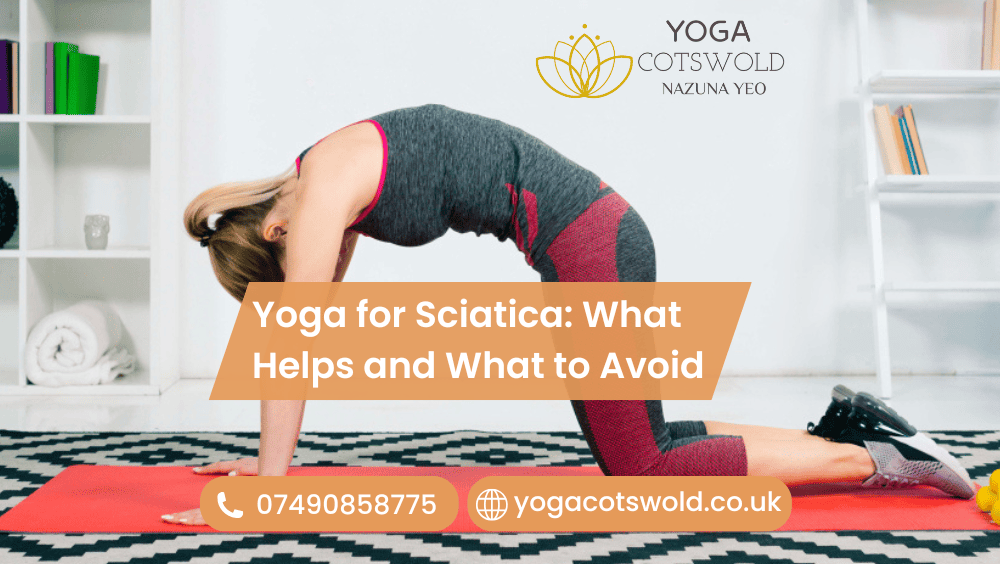
Cat–Cow (slow, small range)
Pelvic—tilts on your back
Knee-to-chest
2) Strength for the glutes and core (support creates relief)
When the glutes and deep core are underactive, the lower back can overwork. Therefore, building strength often reduces that “pinchy” feeling.
Helpful options:
Bridge pose (keep ribs soft, lift from glutes)
Bird-dog (slow, stable, no wobble)
Side-lying clamshell (not glamorous, very effective)
3) Hip-opening with control (space, not strain)
Some hip opening can reduce compression around the pelvis. Still, it must be gentle.
Try:
Figure-4 stretch on your back (support head and neck)
Supported pigeon (a cushion under the hip, short hold)
Reclined twist (knees together, move slowly)
If you feel tingling or shooting pain, ease off immediately.
4) Breathwork to settle the nervous system
Pain is not just tissues; it’s also the nervous system’s alarm. So, breathing is not “extra”—it’s part of the therapy.
Simple practice:
inhale 4 counts, exhale 6 counts
repeat for 2–4 minutes
This longer exhale encourages the body to downshift. Looking for a Yoga Teacher in Pittville?
A simple “helpful” sequence (10–15 minutes)
Use this on calmer days. On flare days, do less.
Constructive rest (on your back, knees bent) – 1–2 minutes
Pelvic tilts – 6–10 slow rounds
Cat–Cow – 6–8 rounds, small range
Bird-dog – 3 each side (slow)
Bridge pose – 5 gentle lifts, pause at top for one breath
Figure-4 stretch – 30–45 seconds each side (very mild)
Supported twist – 30 seconds each side
Breathwork – 2 minutes
This blend covers mobility + stability + calming, which is often the sweet spot for sciatica relief. Get details on Yoga Teacher in Prestbury.
What to avoid: common yoga mistakes that can worsen sciatica
1) Deep forward folds with straight legs
Forward folding can tug on irritated tissues and load the lower back. Also, hamstring stretching can irritate the nerve in some people.
Avoid (especially during flares):
long holds in Standing Forward Fold
intense Seated Forward Bend
If you do fold, bend the knees and keep the spine long.
2) Aggressive hamstring stretching
This surprises many people. Yet when the nerve is sensitive, stretching the hamstrings hard can feel like “good stretch” at first and then spike symptoms later.
Instead: choose gentle hamstring mobility, not force.
3) Big backbends done “from the lower back”
If your lumbar spine compresses during backbends, symptoms may worsen.
Be cautious with:
deep Wheel
strong Cobra with hips heavy
If you backbend, keep it mild and supported, and think of length rather than crunch.
4) Strong twists under load
Deep twists can irritate the spine when tissues are already grumpy.
Avoid:
deep twists while binding
forcing the knee across the body
Keep twists easy and breath-led.
5) “Pushing through pain” thinking it will loosen
If pain shoots, burns, or tingles, that’s not a flexibility signal. It’s a warning sign.
Rule of thumb: If symptoms travel down the leg during a pose, stop and modify. Looking for a Yoga Teacher in Stow-on-the-Wold?
Smart modifications that make yoga safer
Use blocks under hands in standing poses to reduce pulling
Place a cushion under hips in supported pigeon
Keep knees bent in folds
Practise near a wall for balance so you don’t grip
Shorten holds and do more gentle repetitions
Small—changes can make yoga for lower back pain & sciatica feel supportive rather than risky.
When to get extra help
If you have numbness, weakness/loss of bowel/bladder control, seek urgent medical—advice. Also, if pain is severe or not improving, a physio can help identify whether your sciatica is driven more by the spine, hip/soft—tissues. Yoga works best as part of a sensible plan, not as a lone rescue—mission.
Related Articles:
» Yoga for Arthritis: Joint-Safe Movement You’ll Enjoy
» Yoga for Knee Pain: Strength Without Strain
» Yoga for Glutes and Hips: Build Strength Without Bulking
» Yoga for Lower Back Pain: A 15-Minute Daily Sequence
» Yoga for Chronic Pain and Inflammation
Closing note from Nazuna Yeo
If you’re dealing with sciatica, you’re not “broken”. You’re just going through a tender phase. You don’t need to start with an intense practice, but rather keep it gentle for sciatica relief that won’t push your body to the max. If you want a personalized plan, YOGA COTSWOLD can work with you to create your own stable, confidence-building practice — one calm breath at a time.
FAQs: Yoga for Sciatica
1) Can yoga cure sciatica permanently?
Yoga can reduce symptoms and improve function for many people, but a “permanent cure” depends on the cause. However, consistent practice often helps long-term.
2) What is the best yoga pose for sciatica?
There isn’t one best pose. Still, gentle bridge, figure-4, and cat–cow are commonly tolerated.
3) Should I stretch my hamstrings if I have sciatica?
Often, not aggressively. If stretching triggers tingling/shooting pain, back off & focus on gentle—mobility plus strength.
4) Is pigeon pose good for sciatica?
It can be, but it must be supported. Use cushions and keep the sensation mild. If symptoms travel down the leg, stop.
5) Are forward folds bad for sciatica?
They can be, especially with straight legs and long holds. Try bending knees and folding only slightly.
6) Can backbends help sciatica?
Mild—backbends may help some people, especially if symptoms ease with extension. However, deep backbends can compress the lower back, so go gently.
7) What breathing helps sciatica pain?
Slow—breathing with a longer exhale often helps settle tension & reduce pain sensitivity.
8) How often should I do yoga for sciatica?
Short daily—sessions usually work better than occasional long sessions, especially at the start.
9) What if a pose feels good during class but I feel worse later?
That’s a sign you did too much intensity or too long. Next time, reduce range, shorten holds, and prioritise stability.
10) Is walking better than yoga for sciatica?
Walking can be brilliant, and yoga can complement it. Many people do best with both: gentle walking plus stabilising yoga.
Contact
info@yogacotswold.co.uk
Social Media
Get in Touch
07490858775








Address: GEORGE MOORE COMMUNITY CENTRE- BOURTON ON THE WATER
Moore Road, Bourton on the Water GL54 2AZ