
Yoga for Flexibility: Split Training Without Overstretching
Improve flexibility safely with yoga for split training without overstretching. Use gentle warm-ups, deep breathing, and slow hip-opening poses.
HEALTH TIPS
2/4/20265 min read
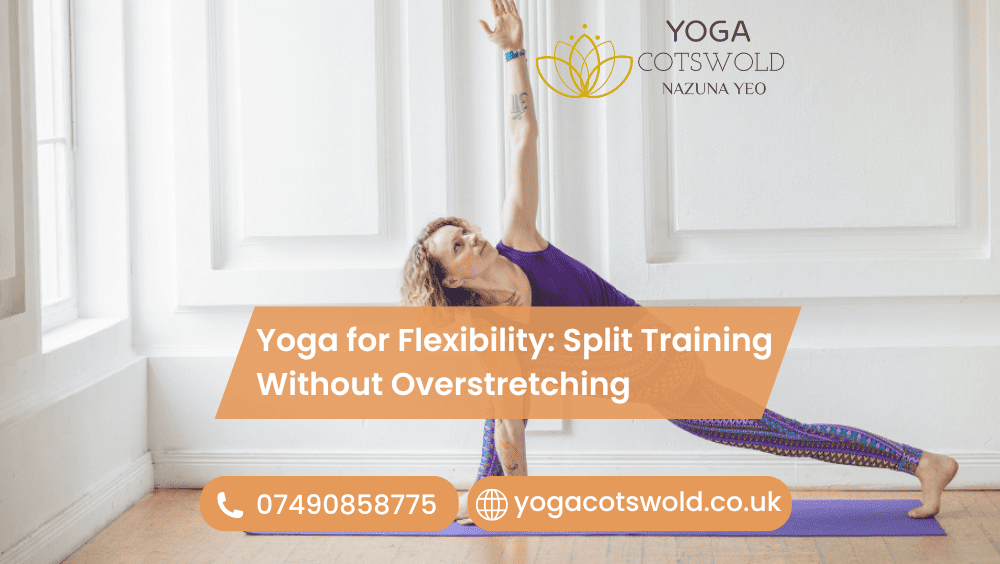
If you’ve ever watched someone glide into the splits and thought, “I want that… but I also want my hamstrings to stay attached,” you’re in the right place. Split training can be a brilliant goal for yoga for flexibility, yet it can also tempt people into forcing range too quickly. And that’s where those niggly aches, pinchy hips, and “why does my hamstring feel weird?” moments start.
And the good news is: you can work toward front splits and middle splits in a way that’s calm, consistent, and body-smart. Actually, the safest one is sometimes that one which seems relatively slower than the seller feeling stronger. So we’re going to talk about how to gain flexibility without overstretching, and how to make those gains You Know Stick.
Why overstretching happens in split training
Splits look like a flexibility challenge, but they’re also a strength and control challenge. Overstretching usually creeps in when you:
chase shape over sensation
drop into your end range without support
rely on passive hanging rather than active engagement
skip warm-ups because “I’m already bendy”
ignore sharp, electrical, or pinching signals
Also, flexibility can improve faster than your tissues can adapt if you push hard, especially when you stretch daily without recovery. That’s why split training without overstretching needs structure, not just effort. Get details on Yoga Teacher in Leckhampton.
The flexibility trio: mobility, strength, and nerves
To train splits well, think of flexibility as three overlapping parts:
Mobility – how much range your joints and soft tissue allow
Active flexibility – how much of that range you can control with strength
Nervous system tolerance – whether your body feels safe in that range
If one piece lags behind, your body tightens up to protect you. Therefore, “more stretching” isn’t always the answer. Instead, we use strength-based flexibility so your body trusts the position.
A quick self-check before you stretch
Before each session, do this 20-second scan:
Can you breathe smoothly through your nose?
Do you feel warm enough to move, not just sit?
Is today a “steady” day or a “tight” day?
Any sharp pain anywhere? If yes, change the plan.
Progress comes from listening early, not regretting later. Looking for a Yoga Teacher in Pittville?
Warm-up for splits: don’t skip this bit
A proper warm-up makes your tissues more pliable and your movement more coordinated. Try 6–8 minutes of:
Cat–Cow to wake up spine and pelvis
Low lunge waves (rocking gently forwards/back)
Downward Dog pedal(bend one knee and then the other)
Sun Salutation A (slow, controlled)
Leg swings (front/back and side/side, small range first)
You should generally feel warmer, not depleted. Then you’re in the market for deeper work.
Front splits: what’s actually stretching?
In front splits, both legs matter:
Front leg: hamstrings (often the loudest sensation)
Back leg: hip flexors and quads (often the hidden limiter)
Hips: need stability and square-ish orientation
Many people overstretch the front hamstring while the back hip stays tight. So, we train both sides with balance. Get details on Yoga Teacher in Prestbury.
Key cues for safer front splits
Keep a micro-bend in the front knee while warming up
Lift your belly gently (avoid collapsing into the low back)
Use blocks under hands so you don’t dump into joints
Stop at “strong stretch”, not “sharp stretch”
Middle splits: adductors need respect
Middle splits target inner thighs (adductors) and also require hip rotation and pelvic control. Because adductors can feel “fine” until they suddenly don’t, middle splits demand gradual loading.
Try this progression instead of forcing the floor:
Wide-legged forward fold (hands on blocks)
Skandasana side-to-side (slow, supported)
Frog pose (short holds, lots of breath)
Supported straddle with bolsters under hips
If you feel a deep tug near the groin that feels unstable or sharp, come out. There’s no prize for tearing something. Looking for a Yoga Teacher in Stow-on-the-Wold?
The secret ingredient: active flexibility
If you want splits that feel stable, train active flexibility. That means contracting muscles while they lengthen. It teaches your body: “This range is safe.”
Two simple strength drills (gold for split training)
Hamstring sliders (or heel drags)
From a half split shape, gently drag your front heel back without moving it.
Hold 5 seconds, relax, repeat 5 times.
You’ll feel the hamstrings “switch on”, not just stretch.
Hip flexor lifts (low lunge)
In a low lunge, press down through the back toes and lightly lift the back knee 1–2 cm.
Hold 3 breaths, lower, repeat 3–5 times.
This builds hip flexor strength and protects the front of the hip.
Do these before your longer holds. You’ll often get more range with less strain. Get details on Yoga Teacher in Northleach.
How long should you hold stretches?
Long holds can help, but only if you’re warm and well-aligned. For split training, try:
2–3 rounds of 30–60 seconds per shape
rest 20–30 seconds between rounds
finish with gentle movement (not an abrupt stop)
Also, the train splits 2–4 times per week, not necessarily every day. Recovery is where tissues adapt.
A simple “split-safe” mini sequence (15–20 minutes)
Use this 2–3 times a week:
Warm-up flow (6–8 minutes)
Low lunge (30 sec each side)
Half split with heel drag activation (2 rounds each side)
Lizard pose (hands on blocks) (30–45 sec)
Pigeon or reclined figure-four (45 sec)
Supported split prep (front split or straddle) 2 rounds
Gentle supine twist + slow breathing (2 minutes)
What I love about this routine is that it focuses on flexibility but doesn’t just mindlessly stretch, as blending mobility, strength and calming work for the nervous system. Looking for a Yoga Teacher in Moreton-in-Marsh?
Common mistakes that slow progress
Even with great intentions, these habits can stall you:
stretching cold and going straight to end range
holding your breath (your body reads that as threat)
forcing hips square at all costs (sometimes that’s too aggressive early on)
ignoring the back leg in front splits
pushing through sharp sensations
Instead, choose consistency, support, and small honest gains.
Related Articles:
» Yoga for Scoliosis: Gentle Poses to Even Out Tension
» Restorative Yoga for Chronic Fatigue and Burnout
» Morning Yoga for Beginners: 10-Minute Wake-Up Flow
» Yoga for Glutes and Hips: Build Strength Without Bulking
» Yoga for Arthritis: Joint-Safe Movement You’ll Enjoy
When to be cautious
If you have had strains in your hamstring, symptoms of hip impingement (pinching in the front of your hip), groin pain or joint hypermobility, splits require additional care. In those instances, consult a teacher who can modify angles, props, and strength drills for your body.
At Yoga Cotswold, Nazuna Yeo is known to say that flexibility is a relationship, not a fight. You trust your body, and it gradually gives you range back — somewhat predictably.
FAQs on "Yoga for Flexibility"
1) How long does it take to get the splits?
It varies hugely. Some of the bodies are recovered months later, others years. Consistency, recovery and strength work matter more than speed.
2) Should I train splits every day?
Not usually. 2–4 times weekly is plenty for most people. Your tissues need recovery time to adapt.
3) What does overstretching feel like?
Sharp pain, burning, tingling, or an unstable “pull” (especially near hamstring attachment or groin). Strong stretch is fine; sharp is not.
4) Is yoga enough to get the splits?
Yes, if you include active flexibility and strength work. Passive stretching alone often plateaus.
5) Front splits: do my hips need to be perfectly square?
Work towards square hips over time, but don’t force it immediately. Use props and gradual alignment changes.
6) Middle splits feel risky—what’s safest?
Progress slowly with support (bolsters/blocks), add gentle strength drills, and avoid sudden deep drops into frog or straddle.
7) Can tight hip flexors block my front splits?
Absolutely. Many people stretch hamstrings endlessly while the back-leg hip flexors are the real limiter.
8) What’s the best time to stretch—morning or evening?
Any time you’re warm and can concentrate. For the safety conscious, many people feel safer later in the day but a good warmup is fine any time.
9) Do I need to feel intense stretch to improve?
No. Moderate sensation with controlled breath often creates better results in the long term.
10) Is PNF stretching safe for splits?
It can be, when done gently and not to exhaustion. Use light contractions, short rounds, and never force end range.
11) Why do I get hamstring tightness after split practice?
You may be overstretching or lacking strength in that range. Add hamstring activation drills and reduce depth temporarily.
12) What props help most for split training?
Yoga blocks, bolsters, blankets, and straps. Props aren’t “cheating”—they’re smart support while your body adapts.
Contact
info@yogacotswold.co.uk
Social Media
Get in Touch
07490858775








Address: GEORGE MOORE COMMUNITY CENTRE- BOURTON ON THE WATER
Moore Road, Bourton on the Water GL54 2AZ