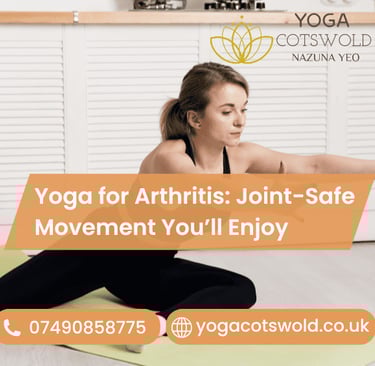
Yoga for Arthritis: Joint-Safe Movement You’ll Enjoy
Yoga for arthritis builds strength and eases stiffness. Moreover, stretches support joints. However, start slowly. Also breathe deeply.
HEALTH TIPS
12/1/20255 min read

Living with arthritis can feel like your body has turned a little stubborn.Yet,with the right approach,movement becomes medicine. At YOGA COTSWOLD,I design classes that blend joint-safe movement,breathwork & mindfulness so you can move with more ease,strength & confidence.This guide explains how yoga for arthritis supports stiff/sensitive joints,what to try at home & how to practise safely—so you actually enjoy it.
Why Yoga Helps Arthritic Joints
Arthritis isn’t just one thing. Many of the students arrive with osteoarthritis, while others are dealing with rheumatoid arthritis or psoriatic arthritis. Regardless of form, flare-ups typically bring stiffness, pain and fatigue. It’s beneficial to have a personalized yoga practice because:
Lubricates joints: Gentle movement encourages synovial fluid to circulate, so joints glide more comfortably.
Builds strength: Strong muscles support and protect cartilage, reducing pressure on painful joints.
Improves mobility: Gradual range-of-motion work reduces stiffness and helps you move more freely.
Calms the nervous system: Breath-led mindfulness lowers stress chemistry that can aggravate pain.
Boosts balance: Better proprioception means fewer wobbles and less fear of falling.
Most importantly,yoga gives you practical tools. You’ll learn when to adapt, when to rest, and how to move well—even on tricky days. Get details on Yoga Teacher in Cheltenham.
Principles of Joint-Safe Yoga
Before we chase any pose,we commit to principles that keep practice kind & effective.
Warm up thoroughly
Start with circulation—boosting moves:ankle rolls,wrist circles,shoulder shrugs & easy spinal waves.Gradual warmth prepares tissues & reduces the chance of a flare.Move in small ranges first
Begin with micro-movements. As joints feel safer, expand the arc. Pain above a mild “2 out of 10”? Dial it back.Use props proudly
Blocks, straps, bolsters, cushions, and the wall transform strain into support. Chair yoga counts as real yoga; it often unlocks better alignment and steadier balance.Prioritise breath
Steady nasal breathing relaxes guarding muscles.Try a simple inhale for 4,exhale for 6 rhythm to ease tension.Favour functional patterns
Focus on movements you need daily—reaching, squatting to a chair, turning to look over a shoulder, stepping up.Finish with restoration
A brief restorative sequence or Yoga Nidra resets the system and supports recovery.
A Gentle Sequence You Can Enjoy Today
Use this outline on light-to-moderate days. If you’re flaring, skip the standing work and stay seated or supine. Move with curiosity, not force.
1) Breath & Arrival (3–5 minutes)
Seated on a chair or bolster, soften your jaw and breathe. Lengthen the exhale slightly. Imagine space around your joints.
2) Upper-Body Mobility (5 minutes)
Wrist circles with fingers relaxed.
Elbow bends with gentle forearm rotation.
Shoulder rolls forward and back, then scapula glides (shoulders up, back, down, forward).
Neck mapping: small yes/no movements; then ear to shoulder with support from your hand (no pulling).
3) Spine & Hips (6–8 minutes)
Cat-cow at the chair or on all fours with hands on blocks.
Pelvic tilts and seated figure-four (cross ankle over knee; flex the foot; hinge a little).
Supported lunge at a wall for soft hip extension.
4) Gentle Strength (6–8 minutes)
Sit-to-stands from a chair, arms reaching forward.
Wall push-ups for wrists and shoulders.
Heel raises holding the back of the chair; then slow toe taps for ankle mobility.
5) Standing Balance (3–4 minutes)
Tandem stance with a fingertip on the wall.
Tree pose with toes on the floor/foot to ankle,using the wall as needed.
6) Cool-Down & Soothe (5 minutes)
Hamstring flossing with strap (small bends and straightens).
Supine twist with a bolster between knees.
Supported Savasana with legs on a chair;cover with a blanket.
This plan blends mobility,strength,balance & relaxation—the four pillars of joint-safe yoga. Looking to a Corporate Yoga Trainer for Companies in Cheltenham?
Styles That Work Well
Not every class suits every body. However, many students with arthritis thrive in:
Gentle Hatha:Steady,slower pacing with time to adjust alignment.
Restorative Yoga:Long,supported rests that calm the nervous system.
Yin-inspired mobility:Short,well-propped holds for tissues—kept comfortable,never sharp.
Chair Yoga:Full practice from a chair/with a chair’s support—excellent for knees,hips & wrists.
Poses to Modify (and How)
Rather than avoid classics, adapt them.
Downward Dog → Hands on blocks or the wall to reduce wrist and shoulder load.
Lunge → Back knee on a folded blanket; hands on blocks to ease hip depth.
Warrior II → Shorten stance; keep a micro-bend to protect knees.
Plank → Use the wall or a table; focus on core engagement rather than angle intensity.
Cobra → Swap for Sphinx with forearms down to support lower back and wrists.
When You’re Flaring
On high-symptom days,compassion wins.
Choose breathwork,guided relaxation & small range-of-motion drills.
Keep warmth:a shower,light layers & a gentle warm-up.
Practise legs up the chair, constructive rest, and body scan meditation.
Reduce stance loads; avoid fast sequences.
You still practised. That counts. Get details on Group Yoga Classes in Cheltenham.
Working with NAZUNA YEO at YOGA COTSWOLD
I teach with a trauma-informed, evidence-aware approach and a friendly Cotswold welcome. We progress gradually, celebrate small wins, and tailor each session. Private lessons & small-group classes in the Cotswolds help you build consistency,learn joint-safe alignment, & feel genuinely supported.
Safety Checklist
Before you roll out your mat,run through this quick list:
Medical team on board:If you’re unsure,consult your GP/specialist first.
Pain scale honest:Aim to stay below 2–3/10;stop if pain sharpens/lingers.
Props ready: Chair, blocks, strap, cushions, blanket.
Pace steady: Slow transitions protect joints more than big stretches do.
Progress visible: Track sleep, stiffness, and mood as well as range of motion.
Sample Weekly Plan
Because structure builds confidence,try this template:
Day 1 – Mobility & Breath : Chair sequence,cat-cow,shoulder rolls,easy balance.
Day 3 – Gentle Strength: Sit-to-stand,wall push-ups,supported lunge,short restorative close.
Day 5 – Restore & Reset : Prop-rich restorative yoga,body scan,soft hip openers.
Daily – Micro-moves (5–10 mins): Neck mapping, wrist circles, ankle pumps while the kettle boils.
Consistency trumps intensity; your joints will thank you.
Related Articles:
» Yoga Teacher in Stow-on-the-Wold
Ready to Begin?
Arthritis changes how you move;yoga changes how you feel about moving.With thoughtful progress,smart modifications & supportive teaching,you can reclaim ease & enjoy your body again. Join me, NAZUNA YEO, at YOGA COTSWOLD for gentle yoga that meets you where you are—and takes you somewhere brighter.
FAQs: Yoga for Arthritis: Joint-Safe Movement You’ll Enjoy
1) Will yoga make my arthritis worse?
No—when you use joint-safe modifications and listen to pain signals, yoga usually reduces stiffness and improves function. Start gently and progress gradually.
2) Which style is best to begin with?
Choose gentle hatha or chair yoga. Both allow careful alignment, slower pacing, and plenty of props.
3) What if my wrists hurt in weight-bearing?
Try the wall for Downward Dog or Plank, use wedges under palms, or switch to forearm variations. Comfort first.
4) Can I practise during a flare?
Yes, but change the plan. Favor breathwork, restorative yoga and small range-of-motion drills. Avoid heavy lifts while symptoms are acute.
5) How often should I do yoga for arthritis?
Little and often works best. Try 3 short workouts a week and daily micro-moves
6) Do I need equipment?
A chair, two blocks, a strap, and a blanket help massively. Improvisations—books, scarves, cushions—also work.
7) Are there poses I must avoid?
Avoid sharp pain rather than specific poses. Modify kneeling, deep squats, and long wrist holds as needed.
8) Will yoga help my balance?
Yes. Proprioception improves through gentle single-leg and tandem work, especially with wall support.
9) Can yoga reduce medication needs?
Yoga supports comfort and function; however, your GP manages medication. Use yoga alongside your medical plan.
10) How soon will I feel results?
Many notice softer stiffness within 2–4 weeks of consistent practice. Strength and confidence keep building with time.
11) Is breathing really that important?
Absolutely. Longer exhales calm the nervous system,reducing muscle guarding & perceived pain.
12) How do I start with Nazuna at Yoga Cotswold?
Book a 1:1 assessment or join a small-group intro. We’ll map your goals, choose joint-safe variations, and begin at a pace that feels kind.
Contact
info@yogacotswold.co.uk
Social Media
Get in Touch
07490858775






Address: GEORGE MOORE COMMUNITY CENTRE- BOURTON ON THE WATER
Moore Road, Bourton on the Water GL54 2AZ