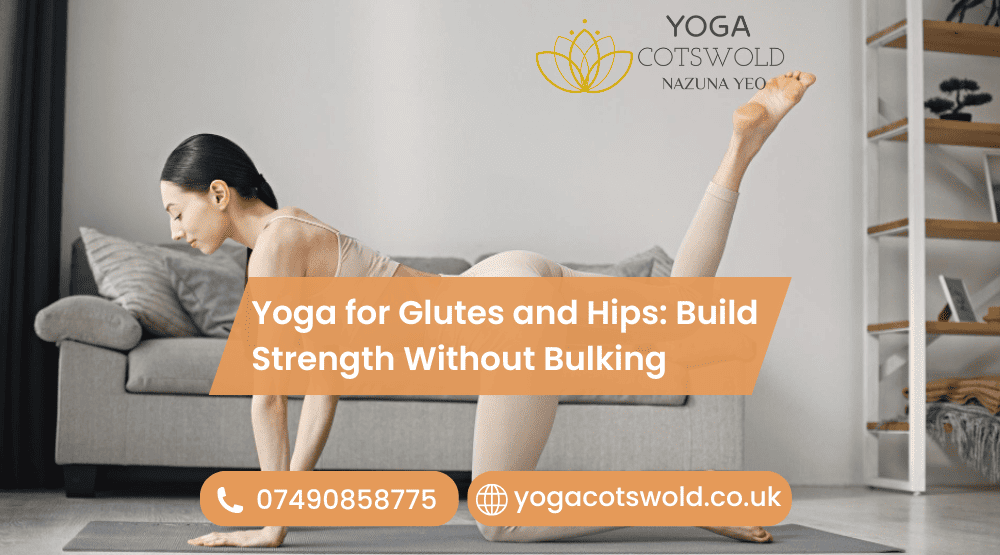
Yoga for Glutes and Hips: Build Strength Without Bulking
Yoga for glutes and hips improves strength effectively. Moreover, it tones muscles without bulking.
HEALTH TIPS
12/15/20255 min read
Strong hips and glutes are not for appearance’s sake only. They’re for feeling stable when you hike up hill, sure-footed when you balance and supported when you bend, lift or just stand around. And if you’re ever felt tight across the front of your hips or achy in your lower back after sitting for a while, then you’ve already met the real reason this area is important.
The brilliant thing is, yoga for glutes and hips builds strength in a way that’s controlled and joint-friendly. Moreover, it helps you move better at the same time. So rather than “training hard and stretching later”, you’re doing both together. As a result, you can build strength without bulking—while still feeling toned, lighter on your feet, and more comfortable in your body.
In this article, I’ll walk you through why the hips get tight, why glutes can feel “switched off”, and which yoga poses actually help. Then, I’ll give you a short flow you can repeat each week to make progress without turning yoga into a bootcamp.
Why glutes and hips get weak (even if you’re active)
You can be a busy, active person and still have sleepy glutes and stubborn hips. In fact, it’s incredibly common. Here’s why:
Sitting—shortens the hip flexors, especially at the front of the hip.
Then, the pelvis often tips forward, which can make the lower—back overwork.
Meanwhile, the glutes don’t fire as well, so the body recruits other muscles (often hamstrings or the back).
Over time, you feel tightness, wobbliness, or that “pinchy” sensation in hip-heavy shapes.
In other words, it isn’t about trying harder. Instead, it’s about teaching the right muscles to do the right job again. Get details on Yoga Teacher in Pittville.
“Strength without bulking”: what yoga really does
Let’s be honest: many people avoid glute work because they imagine bulky thighs or a gym-style build. However, yoga strength is typically different.
Yoga tends to build:
endurance strength (steady holds, controlled transitions)
stability strength (small muscles around hips doing their job)
range strength (strength at length, not just in one position)
So rather than bulk, most people feel more “held together”. Additionally, when your hips stabilise, your posture usually improves—and movement feels smoother. Looking for a Yoga Teacher in Prestbury?
The key idea: hips need both mobility and stability
A lot of “hip routines” focus only on stretching. But if you stretch without strengthening, your hips could remain unstable. Conversely, if you simply strengthen the front of your hips without opening them, you might end up feeling stuck or tight.
So we aim for balance:
glute activation (power and support)
hip flexor release (space at the front of the hip)
core support (so the pelvis stays steady)
When those three work together, your hips feel strong and spacious.
How to feel the glutes properly (without gripping or clenching)
Before we jump into poses, here are cues that make a huge difference:
Breathe out to engage. Your exhale helps your deep core support the pelvis.
Firm, not clenched. Engage the glutes, but keep the jaw soft and breath smooth.
Track knees forwards. In squatting shapes, avoid the knees collapsing inward.
Level your “hip headlights”. When one hip drops, the glutes don’t work as well.
If you feel cramping in hamstrings during glute work, don’t panic. Usually, the glutes are simply not joining in yet. With practice, that changes. Get details on Yoga Teacher in Stow-on-the-Wold.
Best yoga poses for glutes and hips (strength-focused, no bulking vibe)
1) Chair Pose (Utkatasana)
This looks simple, yet it’s powerful when done slowly.
How to do it well: sit back as if reaching for a chair, keep weight in heels & lift through the chest.
Make it glute-focused: press knees gently out & hold for 5–8 breaths.
2) Crescent Lunge (High Lunge)
This builds glutes and legs while opening the hip flexors.
Key cues: keep the ribs stacked (no big backbend), and aim the tailbone down slightly.
Option: add 5 slow pulses on the exhale, then hold.
3) Warrior III (Virabhadrasana III)
This is one of the best poses for real-life hip stability.
Try this: keep a micro-bend in the standing knee, square the hips, and reach through the lifted heel.
Make it accessible: use blocks or fingertips on a wall.
4) Bridge Pose (Setu Bandhasana)
Bridge is classic glute activation without impact.
Set-up: feet hip-width, heels under knees, arms by sides.
Action: exhale lift, inhale lower—slowly. Do 8–12 reps.
5) Locust Pose (Salabhasana)
This strengthens glutes and the back line while improving posture.
Important: lift only as high as you can without crunching the lower back.
Do: 3 rounds of 3–5 breaths.
6) Side-lying leg lifts (yoga-style)
This targets the glute medius, which stabilises your pelvis when you walk or balance.
Cue: turn toes slightly down, lift slowly, lower even slower.
Do: 10–12 reps each side.
7) Figure-4 stretch (or supported Pigeon)
Strength work lands better when the hips can also soften.
Option A (gentle): on your back, ankle over opposite knee, draw legs towards you.
Option B (deeper): Pigeon, supported under the hip with a block if needed. Looking for a Yoga Teacher in Moreton-in-Marsh?
A repeatable 15-minute yoga flow for glutes and hips
Do this 2–4 times a week. Keep it steady, and you’ll feel the difference.
Cat–Cow (1 minute)
Low Lunge (5 breaths each side) – add gentle rocking forward/back
Chair Pose (6 breaths)
Crescent Lunge (5 breaths each side) + 5 slow pulses
Warrior III (3 breaths each side, twice)
Bridge Pose (10 slow reps)
Locust Pose (3 rounds, 3 breaths each)
Figure-4 stretch (8 breaths each side)
Supine twist (5 breaths each side)
Although it’s short, it’s effective. And because it’s manageable, you’ll actually do it.
Common mistakes (and quick fixes)
Mistake 1: Dumping into the lower back
If the lower back is doing all the work, reduce the depth and focus on ribs stacked over pelvis. Also, exhale more fully.
Mistake 2: Knees collapsing inward
This often switches off the glutes. Instead, keep knees tracking over toes, even if the pose becomes smaller.
Mistake 3: Stretching only
Stretching feels nice; however, hips also need stability. So pair stretches with strength every time.
Mistake 4: Rushing
Speed hides compensation. Slow down, and you’ll recruit the right muscles. Get details on Yoga Teacher in Swindon Village.
How often should you practise?
Two sessions a week is a solid start for most humans. Then, if your body likes it, throw in a third or fourth shorter session. In addition, walking, hiking and mild strength work all reinforce hip health. The secret is consistency, not intensity.
Related Articles:
» Yoga for Chronic Pain and Inflammation
» Yoga for Lower Back Pain: A 15-Minute Daily Sequence
» Can Yoga Help Manage Chronic Pain?
» Yoga for Chronic Pain Relief: A Natural Way to Manage Discomfort
» Yoga for Chronic Pain Management: Move with Ease, Live with Comfort
A final word from NAZUNA YEO
Your hips don’t need punishment. They need smart attention: strength, space, and steady practice. So if you seek yoga for glutes and hips that helps tone strength — but without building bulk — look for a practice painted with control, alignment and repeatable movements. In time, you’ll also feel more steady and more open, and much more at home in your body.
FAQs: Yoga for Glutes and Hips
1) Can yoga actuallystrengthen glutes?
Yes. Poses like Bridge, Chair, and Warrior III build endurance and control in the glutes.
2) Will yoga make my legs bulky?
Typically, no. Yoga usually develops lean, functional strength rather than bulk.
3) How soon will I feel results?
Often within 2–4 weeks you’ll notice better stability, especially in balance and lunges.
4) Why do my hips feel tight even after stretching?
Because tightness can come from instability. Add strengthening alongside mobility work.
5) What if lunges feel pinchy at the front of my hip?
Make the stance shorter, keep pelvis neutral, and focus on glute engagement.
6) Is Pigeon Pose safe for everyone?
Not always. If it feels sharp or pinchy, choose a Figure-4 stretch instead.
7) Why do my hamstrings cramp in Bridge Pose?
Often the glutes aren’t firing yet. Bring heels slightly closer and press through the whole foot.
8) Which pose is best for glute activation?
Bridge Pose is a great starting point because it’s stable and easy to adjust.
9) How do I work my hip stability?
Add Warrior III, side-lying leg lifts, and slow transitions between lunges.
10) Can yoga help with lower back discomfort?
It can, especially if your back is overworking due to weak glutes or tight hip flexors.
Contact
info@yogacotswold.co.uk
Social Media
Get in Touch
07490858775








Address: GEORGE MOORE COMMUNITY CENTRE- BOURTON ON THE WATER
Moore Road, Bourton on the Water GL54 2AZ