Top Yoga Practices to Build Strength, Flexibility, and Focus
Discover top yoga practices boosting strength, flexibility, and focus naturally. Daily yoga poses, mindful breathing, and balanced routines improve posture.
HEALTH TIPS
5/22/202612 min read
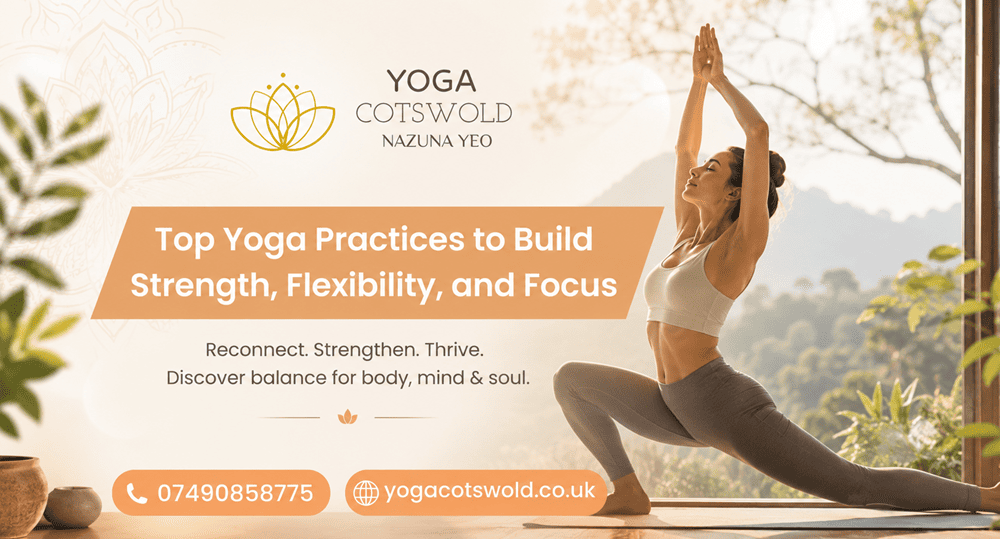
It isn't getting your feet behind your head, or hanging off the ceiling, or similar looking calm while wrestling with the coiling compulsion about that hidden left foot of yours. Its learning to understand how your body breaths, moves, strengthens/softens and becomes aware! No one bothered to ask me, but my name is Nazuna Yeo, and I run Yoga Cotswold – where I regularly have to remind students that you cannot rush yoga.
Where Every Yogi Begins: The Beauty of Being a Complete Beginner
Every student starts somewhere. This led to many postponing their first class, as they assumed that flexibility, calmness, low body weight (in many cases), strength levels and/or spirituality were prerequisites to even set foot in a studio. The truth is that that idea creates more tight shoulders than Downward Dog ever will.
Your beginner yoga practice should be inviting, not intimidating. Back when I first started teaching at Yoga Cotswold, I realised that new students often said sorry before we had even begun. They would say, « I am not flexible ». “I don’t know the names.” “I’ll be terrible.” I always tell every new student exactly the same thing: you cannot be bad at beginning.
For anyone searching for yoga for beginners UK, the real starting point is not a perfect mat or fancy leggings. Instead, it is curiosity. Can you breathe a little deeper? Can you notice tension without judging it? Can you try, wobble, laugh, and try again?
As a Nazuna Yeo yoga teacher, my approach begins with reassurance. Furthermore, I teach students to recognise that strength and flexibility develop through patience, not force. The first stage of growing your yoga practice often feels slow, yet that slowness builds trust. Get details on Yoga Teacher in Leckhampton.
Yoga Fundamentals: The Building Blocks You Cannot Skip
It is better than impressive shapes that you put when the yoga fundamentals matter more. Breathing, alignment, body awareness and steady attention lay the foundation for everything else. Even a beautiful pose is less gratifying without them.
Breath comes first. In simple pranayama, you only learn how to breathe consciously. This calms the nervous system, makes it easier to move, and soothes the frenetic nature of your mind.
Alignment comes next. But alignment is not trying to make everybody the same. Rather, it means putting your body wherever you feel at home in your own skin.
Mountain Pose (Tadasana)
Duration: Hold for 5–8 breaths
START: Stand with feet together, arms at sides Breathe in lightly through your nose, lift up away from the top of your head and breathe out as if to drop those shoulders down and away from those ears.
Alignment tip: Keep a little softness in your knees — so that your legs are Alive and able to react.
Nazuna 1 — Tadasana (Mountain Pose) Nazuna says, "It looks simple, but it teaches you how to stand in your own centre gently."
Child's Pose (Balasana)
Duration: Hold for 6–10 breaths
Kneel, fold forward and have your forehead land on the mat. The moment lingers on, inhale into your back ribs, and as you exhale in soften your hips and jaws, your belly.
Alignment tip: If your hips are hovering above your heels, support them by placing a pillow or blanket underneath.
Keep in mind: Child pose never ever means failure, I have a democratic view on it ( Nazuna)
Downward-Facing Dog (Adho Mukha Svanasana)
Duration: Hold for 5–8 breaths
Start in a tabletop position, you can tuck your toes and hunch forward up out of the squat. Inhale, lengthening through your spine; Exhale as you press through your hands and let your heels melt towards the ground.
AlignmentTip: No Straight Legs > IF your BACK rounds, then you bend.
Nazuna: “Without a doubt, this stage caught me out too while I was learning; a bent-knee Downward Dog can feel much better than a stiff one. Looking for a Yoga Teacher in Pittville?
The Intermediate Stage: Where the Real Growth Happens
Now, this is where it gets interesting; intermediate yoga. And it is also where most students get a bit lost. You are no longer a beginner, but you may still not feel ready for an advanced yoga pose. Welcome to the messy middle.
It is never so much about the outcome as it is about the messy middle. At the same time, you Grow Some Strength and Flexibility Your legs gust through in Warrior poses, your hamstrings grouse, and your balance wings up and down depending on sleep, stress or whether you drank too much coffee. Very human.
At Yoga Cotswold, Nazuna Yeo structures this stage with clear yoga progression tips. We build from familiar poses, add small challenges, and return often to breath. In addition, students learn yoga poses step by step, so progress feels steady rather than reckless.
This is also where yoga stages of learning become clearer. First, you copy the shape. Then, you understand the action. Eventually, you feel the pose from inside. Consequently, growing your yoga practice becomes less about achievement and more about relationship.
Yoga Progression Tips: How to Move Forward Without Pushing Too Hard
Advancement requires zeal, and roll on but it requires constraint. Hence your best yoga progression tips are not dramatic. They are pragmatic, compassionate, and consistent.
Choose consistency over intensity. A little bit day to day, three or four times a week in shorter bursts usually helps more than one epic session on Sunday after which you forget your mat on Monday and so introduce next 6 days of mat burial.
Rest days matter too. In fact, your muscles, joints and nervous system require time to acclimatize from the work. On the flip side, journaling enables you to spot trends. Journal your feelings before practice, write what you practiced, then journal how it was afterwards.
A teacher also helps. Yoga self-practice gives freedom, but classes offer correction, encouragement, and fresh perspective. At the same time, your home practice teaches you honesty because nobody else watches.
Plateaus will happen. However, they do not mean failure. Often, they mean your body is quietly preparing for the next layer. With this in mind, growing your yoga practice works best when you respect both effort and recovery. Get details on Yoga Teacher in Prestbury.
Yoga Consistency: Why Showing Up Matters More Than How You Show Up
Yoga consistency may not be as glamorous as a deep backbend, but that is everything. Daily practice – no matter how small it is – trains your body and your concentration. This in turn improves flexibility, strengthens the body and makes focus easier to achieve.
Consistency works from a teaching perspective; the nervous system wants repetition! Yoga philosophically also beckons us back. Not perfectly. Just honestly.
But for instance, five minutes of breathwork and gentle movement in the morning can serve you more than waiting for an ideal full hour. Short daily sessions put you under less pressure, and this results in a tendency to keep going.
At Yoga Cotswold, I often suggest a simple rhythm: breathe, warm the spine, move through two or three standing poses, then rest. That is enough. Truly.
The yoga mindset behind consistency asks you to stop measuring every practice by performance. Instead, ask: did I show up? Did I listen? Did I leave with a little more space than when I arrived? Get details on Yoga Teacher in Stow-on-the-Wold.
Advanced Yoga Poses: A Honest Look at What "Advanced" Really Means
Advanced yoga does not mean turning yourself into a human pretzel. In contrast, it means refined awareness, steady breath, emotional patience, and enough humility to come out of a pose when your body says no.
Yes, challenging poses can build strength and courage. However, they should never become trophies. A calm breath in a basic pose can show more maturity than a wobbly shape done for pride.
Crow Pose (Bakasana)
Duration: Try 3–5 short attempts
Begin in a squat, place your hands shoulder-width apart, and bend your elbows slightly. Shift your weight forward, squeeze your knees towards your upper arms, and exhale as one foot, then perhaps both feet, lift.
Alignment tip: Look slightly forward rather than straight down, or your balance may tip with you.
Nazuna says: “Crow taught me to be brave in tiny doses; sometimes one lifted toe is enough progress for the day.”
Wheel Pose (Urdhva Dhanurasana)
Duration: Hold for 3–5 breaths
Lie down, bent leg knees together on the floor with your feet hip width apart and just near to / by the side of (natural instincts from behind) your ears. Inhale to get ready, exhale as you press your palms and soles into the floor, raising your chest and hips.
Alignment tip: allow knees to track forward rather than splay widely.
Nazuna: "Never rush Wheel on the spine, it likes to invite not command."
Headstand (Sirsasana)
Duration: Practise preparation first; hold only with guidance
Begin on your forearms or hands, depending on the variation taught by your teacher, and create a stable base. Breathe slowly, draw your ribs in, and lift with control rather than kicking.
Alignment tip: Do not dump weight into your head; your shoulders and core must support the pose.
Nazuna says: “Headstand is not a party trick; learn it slowly, preferably with a teacher beside you.” Looking for a Yoga Teacher in Northleach?
Yoga Mindset: The Inner Journey That Runs Alongside the Physical One
The inner work often surprises students. You arrive wanting flexible hips, and then yoga quietly shows you impatience, comparison, fear, and pride. Cheeky, isn’t it?
But the practice returns at this point to a deeper level. Non-attachment allows you to revel in no progress without the need for attachment. Patience reminds you that bodies are seasonal. When you practice self-compassion, you do not turn yoga into one more job that must be won.
Nazuna Yeo at Yoga Cotswold shows students how to work through mental blocks as she brings them back to breath and sensation. If, for example, someone is feeling irritated I might say, “Can you soften one thing?” Usually, the jaw goes first.
Above all, growing your yoga practice means learning to meet yourself kindly. Not every practice will feel graceful. Some will feel clumsy, distracted, or heavy. Still, they count. Get details on Yoga Teacher in Moreton-in-Marsh.
Building a Yoga Self-Practice: Making the Mat Your Own
A personal home practice does not need to be complicated. Start with ten minutes. Choose one breathing practice, one gentle warm-up, two standing poses, one floor stretch, and rest.
Props help enormously. Use blocks, blankets, cushions, belts, or a sturdy chair. In other words, support does not weaken your practice; it makes it wiser.
For beginners, keep sequences simple. For those at an intermediate level, an inquiry might center around hip mobility, shoulder strength or balance. Or, work toward challenging poses and/or pranayama and meditation for the more experienced.
Yoga Cotswold teaches principles and not just a sequence of postures which helps with this independence. Which works, can be modified and when to take a time out. You have that knowledge gives your home mat a kind of confidence.
Related Articles:
» Simple Yoga Practices to Reduce Stress and Improve Daily Energy
» Why Practising Yoga Daily Can Transform Your Life?
» Yoga for Flexibility: 7 Essential Poses You Should Practice Daily
» Yoga for Better Focus: Brain-Boosting Flow Sequences
» Essential Yoga Tips for Better Posture and Core Stability
A Final Word from Nazuna Yeo
If you are reading this and wondering whether you are ready, let me gently say: you are allowed to begin before you feel ready. That is often how the best things start.
At Yoga Cotswold, I see students arrive with stiff backs, busy minds, old injuries, new hopes, and sometimes a healthy dose of doubt. However, I also see what happens when they keep showing up. Breath by breath, they become stronger, softer, steadier, and more at home in themselves.
So, whether you are starting a beginner class, returning after a long break, exploring intermediate yoga, or building your own home rhythm, take the next step kindly. Bring your real body. Bring your real mood. Bring your questions. I would be very happy to meet you on the mat at Yoga Cotswold.
FAQs: Top Yoga Practices to Build Strength, Flexibility, and Focus
1) I've never done yoga before — where should I honestly start?
If you are ready to get started but nervous, take an easy beginner class, a home practice for limited periods or one-to-one guidance. Do not wait till you are flexible or confident but yoga makes you those over time. A real beginner should be focusing on the breath, basic standing postures and easy stretches and how to relax. At Yoga Cotswold, in Stroud, Nazuna Yeo runs beginner-friendly classes with clear instructions and plenty of encouragement. Be sure to begin with what your body is today, not where you think it should be.
2) How long does it take to progress from beginner to intermediate yoga?
If you go to class regularly, you will be prepared for intermediate yoga most of the time within a few months, but the timing can vary greatly from person to person. To illustrate, practising three times a week will achieve progression more rapidly than going merely once a month. Nevertheless, progress is not only harder. You might also experience an improved awareness of your body, more steady breath, increased strength and greater confidence in adapting poses. That is why Nazuna Yeo advises to walk ahead slowly because reading through it with a rush provides tension rather than growth.
3) Can I practise yoga at home without attending classes first?
So Yes, you can start it at homeSimple BreathingGentle mobilityBasic poses But a teacher helps eliminate habits like holding the breath, collapsing into joints, and pushing. Starting solo should mean sticking to a short and safe regime. On the other hand, visiting certain lessons at Yoga Cotswold can provide you with constructive feedback. The balanced approach works perfectly: learn in class and then practice silently at home.
4) What are the most important yoga poses for a complete beginner to learn?
Mountain Pose, Childs Pose, Downward-Facing Dog, Cat-Cow, Warrior II, Bridge Pose and a simple seated twist provide beginners with a solid baseline. But that does not mean you are lacing into them as though they are just warm up matches. They teach us how to ground, breathe and stretch the spine with such a significant importance for proper leg balance. Consequently, you build your body for more complex work later on. Because they have usefulness at every level, Nazuna Yeo often brings students back to these basics.
5) How do I know when I'm ready to move to an intermediate level?
When you are able to do the simple commands without feeling over-run, have a regular breath in the majority of postures and hear when you need to heal then we come to sense that you are ready. But readiness is not perfection. It means that you know your body well enough to get out of your comfort zone safely. Maybe you're wondering for more powerful standing series or balance postures, longer holds, and right in touch with the growing urge. At Yoga Cotswold students are guided into intermediate classes when they feel both excited and appropriately cautious.
6) Is there an age limit for progressing to more advanced yoga poses?
No fixed age limit exists, but your body, health history, and experience matter. Many older students build excellent strength, balance, and awareness through steady practice. However, some advanced shapes may not suit every spine, shoulder, neck, or wrist. Therefore, “advanced” should always mean appropriate, not extreme. Nazuna Yeo teaches students to honour their stage of life and their individual structure. With good guidance, progress can remain safe, satisfying, and surprisingly joyful.
7) How many times a week should I practise yoga to see real progress?
When practice has breath, strength, mobility, and rest three to four times a week typically shows significant progress. But not all of these sessions have to last an hour. Well, fifteen to twenty minutes is okay while you practice with your focus. Also, I would argue It is better to be consistent than sporadically intense. If your life feels hectic, start with two small sessions and one class. This way, your routine can grow organically over time instead of becoming another added pressure.
8) What should I do when I hit a plateau in my yoga practice?
First, do not panic. Plateaus are normal, and they often mean your body is integrating previous work. However, you can refresh your practice by changing your focus. For example, work on breath for a week, explore slower transitions, use props, or return to foundational poses. In addition, ask a teacher to watch your alignment. Nazuna Yeo often finds that small adjustments unlock progress more effectively than forcing bigger effort.
9) Do I need to be flexible to start yoga — or does yoga make you flexible?
You do not need to be flexible to start yoga. In fact, that is one of the most common myths I hear. Yoga can improve flexibility over time, but it also builds strength, balance, focus, and body awareness. However, flexibility should develop gradually. If you chase deep stretches too quickly, your muscles may guard rather than release. Start gently, breathe well, and let your range increase in a way your body trusts.
10) How does Nazuna Yeo's teaching approach differ from a standard yoga class?
Nazuna Yeo teaches with warmth, clarity, and close attention to individual bodies. Rather than pushing students into fixed shapes, she encourages them to understand the purpose behind each movement. As a result, students learn how to adapt poses, breathe steadily, and develop confidence at their own pace. Her classes at Yoga Cotswold combine careful technique with a relaxed, human atmosphere. You can ask questions, wobble, rest, and still feel completely welcome.
11) What classes does Yoga Cotswold offer for different levels of experience?
Yoga Cotswold supports students at different stages, from beginner-friendly sessions to classes for those exploring stronger or more detailed practice. Beginners can learn breath, alignment, and foundational movement. Meanwhile, intermediate students can build stamina, balance, and flexibility through more layered sequencing. Students with more experience may explore deeper awareness, stronger postures, and meditation. However, the best class depends on your body and goals, so asking for guidance before choosing can help.
12) How do I stay motivated when my yoga progress feels slow?
Begin by measuring progress differently. Instead of only looking at flexibility or difficult poses, notice your breathing, mood, posture, sleep, and patience. Furthermore, keep your practice realistic. A tiny routine you actually do beats a grand plan you avoid. You can also journal small wins, practise with a friend, or attend a class when your energy dips. Above all, remember that slow progress often lasts longer because it grows from understanding.
Contact
info@yogacotswold.co.uk
Social Media
Get in Touch
07490858775






Address: GEORGE MOORE COMMUNITY CENTRE- BOURTON ON THE WATER
Moore Road, Bourton on the Water GL54 2AZ