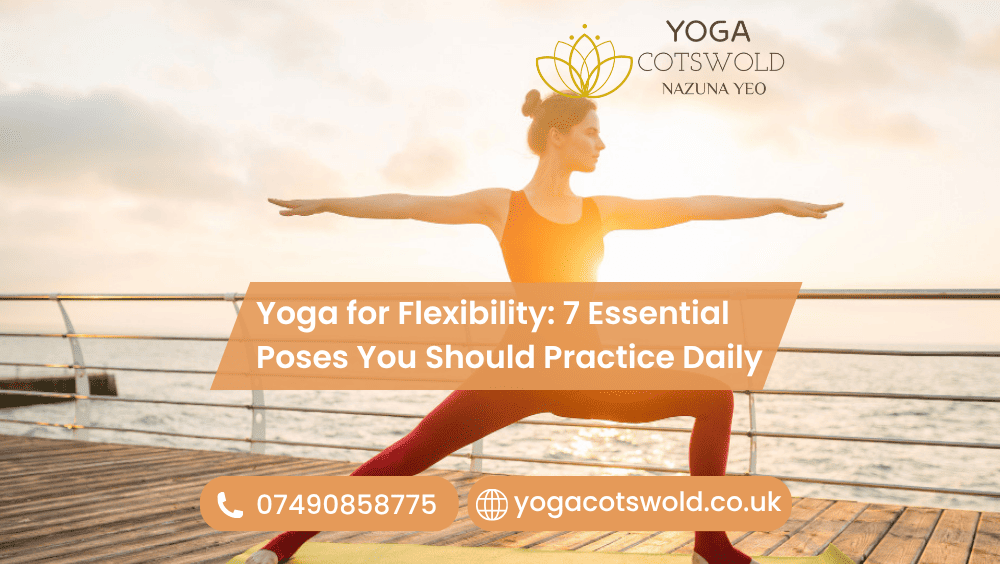
Yoga for Flexibility: 7 Essential Poses You Should Practice Daily
Practicing these seven yoga poses daily can gently improve flexibility, reduce stiffness, and support better posture.
HEALTH TIPS
4/22/20264 min read
Flexibility does not only mean being able to touch your toes or hold an incredible pose. It is the basis of a fit resilient body and a calm focused mind, not conversely. In YOGA COTSWOLD we believe that by increasing flexibility means improving mobility, lower risk of injury and better health overall. That said, building a daily yoga practice into your everyday life can completely change how you move and how you experience life.
Flexibility is something that does not happen overnight and as a yoga teacher, I always insist on this line to my students – Nazuna Yeo But with time and awareness, your body slowly becomes more comfortable. So here below are 7 basic yoga asanas which would help you enhance your flexibility if done every day.
Why Flexibility Matters in Yoga
First of all, flexibility will help improve your posture and alignment. This technique also eases muscular tension from prolonged static-poised posturing or repetitive actions/movements. What is more, freely-moving joints promote balance and coordination as well as flexible muscles.
And, for reasons that include being a mindful movement practice — so yoga for flexibility is also an excellent exercise. Each one of them, as you progress through the poses, connect with your breath and body. That makes you aware of it, that reduces stress and enables you to relax. Get details on Yoga Teacher in Leckhampton.
1. Downward-Facing Dog (Adho Mukha Svanasana)
To start, this traditional posture opens the entire body (hamstrings, calves and shoulders). Start on hands and knees with an inverted “V” shaped spine.
Key benefits:
Lengthens the spine
Improves hamstring flexibility
Strengthens arms and shoulders
The proper execution of the pose is to press your heels firmly down into the floor, unless you need a slight knee bend (bends must be micro), if so, no big deal.
2. Forward Fold (Uttanasana)
Forward Fold The Forward Fold stretches and opens the hamstrings and lower back. First stand tall then bend yourself at the waist forward.
Tips for practice:
Keep your neck relaxed
Engage your thighs slightly
Avoid locking your knees
This also relieves tightness in the back and increases the overall flexibility.
3. Low Lunge (Anjaneyasana)
Low Lunge, on the other hand, opens the hips and stretches out hip flexors — some typically tight muscles from sitting too long.
Why it matters:
Improves hip mobility
Enhances balance
Supports better posture
Furthermore, raising your arms overhead intensifies the stretch and engages your core.
4. Seated Forward Bend (Paschimottanasana)
The other crucial pose is the Seated Forward Bend, which releases tension from the entire back body. Sit with your legs straight and reach them towards their feet
Benefits include:
Deep stretch for hamstrings
Calms the nervous system
Encourages introspection
However, do not round your spine too much. Instead, focus on lengthening forward. Looking for a Yoga Teacher in Pittville?
5. Butterfly Pose (Baddha Konasana)
Butterfly Pose works your inner thigh and opens the hips while forward folds target hamstrings.
How to practise:
Sit upright
Bend or fold the sole of your foot.
Lower your knees to the ground.
With time this pose improves the flexibility of hips significantly.
6. Cat-Cow Stretch (Marjaryasana-Bitilasana)
It also benefits spinal flexibility and coordination when practicing the Cat-Cow Stretch. Arch and round your back, continuous moving between the two.
Key advantages:
Warms up the spine
Relieves tension
Improves posture
This means, that you can use this pose earlier in your practice.
So you could use this pose towards the beginning of your practice.
7. Child’s Pose (Balasana)
Finally, the Child’s Pose provides a gentle stretch for the back, hips, and thighs.
Why include it daily:
Promotes relaxation
Releases lower back tension
Encourages deep breathing
Although simple, this pose plays a vital role in recovery and flexibility. Get details on Yoga Teacher in Prestbury.
How to Build a Daily Yoga Routine
You need to be consistent in order to make the best use of this. Before you start stretching your time quickly, add two or three minutes and pray daily instead. Furthermore, focus on breathing with ease as that allows for deeper stretches.
Equally, listen to your body. You can push yourself all you want, but pain is an absolute wall. Instead, aim for steady progress.
Common Mistakes to Avoid
Yoga looks deceptively gentle and an incorrectly performed technique might delay the process. Example: Doing a stretch too soon can cause an injury. Similarly, breath-holding is potentially tension-creating instead of releasing it.
So focus on alignment and awareness rather than how deep into a pose you can get.
Related Articles:
» Yoga Teacher in Stow-on-the-Wold
» Yoga Teacher in Moreton-in-Marsh
» Yoga Teacher in Andoversford
» Yoga Teacher in Swindon Village
Daily Yoga for Flexibility: Your Next Step Forward
Daily practice of these basic yoga poses can be highly beneficial for flexibility and overall health. Results take time, but the result of the experience has many physical and psychological benefits.
YOGA COTSWOLD believes in yoga which is accessible, enjoyable and sustainable. There is no doubt that if you take the time to practice mindfully, your flexibility will win.
FAQs: Yoga for Flexibility
1. How often should I practise yoga for flexibility?
Ideally, practise daily. But you can still see some results with even 3–4 sessions per week.
2. How long does it take to become flexible?
Ultimately, the results on average are something like within a couple of weeks of consistent practice, and they may be to other people.
3. Can beginners try these poses?
And all of these are good beginner poses with enough guidance and modifications to help them.
4. Is yoga enough to improve flexibility?
Yoga is definitely excellent to practice regularly for increasing flexibility.
5. Should I warm up before yoga?
So to answer your question, yes a bit of warm-up. We do advise it helps prevent injury and prepares our muscles.
6. Can yoga reduce muscle stiffness?
Yes, with practice there is no tension and discomfort.
7. What is the best time to practise yoga?
Mornings are ideal but it would be whatever works for you.
8. Do I need equipment for yoga?
A mat is sufficient. Props (optional): blocks or straps.
9. Can yoga help with back pain?
Some postures are beneficial in curing and dispelling back pain if practiced correctly.
10. Is it normal to feel discomfort during stretches?
Sure, strain is nice and all but stretching should never be sharp.
Contact
info@yogacotswold.co.uk
Social Media
Get in Touch
07490858775








Address: GEORGE MOORE COMMUNITY CENTRE- BOURTON ON THE WATER
Moore Road, Bourton on the Water GL54 2AZ