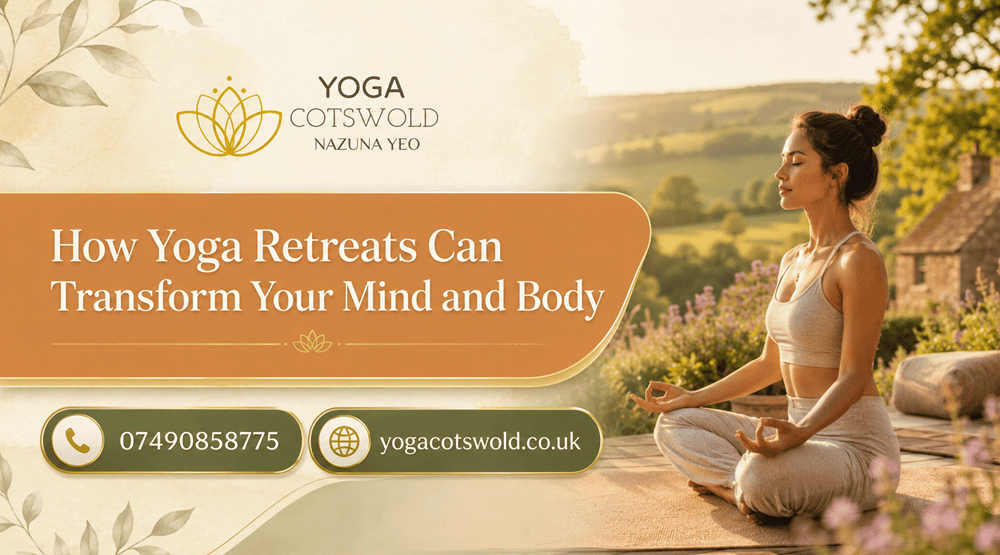
How Yoga Retreats Can Transform Your Mind and Body
Yoga retreats transform your mind and body by reducing stress, improving flexibility, and boosting mental clarity.
HEALTH TIPS
6/8/202613 min read
My usual response when people ask me why yoga retreats seem like something altogether different than a weekly class is to smile first. Growing your yoga practice simply does not happen by pure chance because, whether you know it or not, you are at least a part-time yoga teacher. It shows up when you allow yourself the moment, the room, the breath and a touch of agency to not hurry. At Yoga Cotswold, I have seen students arrive anxious, tight, fatigued or just inquisitive and leave with something less rigid in their shoulders and balanced in their hearts.
Where Every Yogi Begins: The Beauty of Being a Complete Beginner
Every yogi starts somewhere. Usually, that somewhere feels a bit wobbly. When I first started teaching at Yoga Cotswold, I realised many new students worried more about “getting it wrong” than about enjoying the class. However, yoga does not ask you to arrive polished. It asks you to arrive.
A beginner yoga practice often begins with doubt. Will I be flexible enough? Will everyone else know what they are doing? What if I mix up left and right? I still mix up left and right occasionally when I teach, which keeps everyone pleasantly humble. More importantly, those fears dissipate when the breath comes back to base.
When it comes to those looking for yoga for beginners in the UK, I always say this: choose a teacher and environment that gives you a sense of safety instead of judgment. Nazuna Yeo welcomes newcomers into Yoga Cotswold with an open mind, using plainly spoken language and low-pressure practice. Furthermore, I remind every new student that your first victory is not reaching for your toes; it is noticing what you are feeling.
As a Nazuna Yeo yoga teacher approaches, I focus on curiosity before correction. Therefore, beginners learn to ask, “What is my body telling me today?” rather than, “Do I look right?” That small change can transform the whole practice. Get details on Yoga Teacher in Leckhampton.
Yoga Fundamentals: The Building Blocks You Cannot Skip
Yoga fundamentals are the most important thing at all stages. In fact, the experienced students visit them again and again. From those gentler retreats to low-key classes, even starting a home practice, the roots of growing your yoga practice starts with breath, alignment and body awareness.
Breath comes first. Pranayama basically means learning how to control the breath. I can shift the ribs open with a slow breath, or I can relegate my nervous system to crying or sweating. But don't overdo it. Breath must sound like fellowship, not military command.
Alignment comes next. Meanwhile, listening to your body keeps alignment intelligent rather than rigid. One shoulder may sit higher. One hip may resist. That is not failure; it is information.
Mountain Pose (Tadasana)
Duration: Hold for 5–8 breaths
Begin standing tall with the spine upright. Inhale — crown lifts; Exhale — hold on to the softness of your jaw as again, your shoulders come down and onto the back blades.
Trick to level your knees: do not lock the knees, as the lower back tightens a lot.
As Nazuna says, "I love Mountain Pose—you would think it is so easy and then it teaches you everything about being present in silence."
Child's Pose (Balasana)
Duration: Hold for 8–10 breaths
Start kneeling, then inhale as you fold the torso forward so that your forehead is towards the mat. Imagine breathing into your back ribs here releasing tension with every exhale.
Alignment tip: If your hips do not reach your heels, place a blanket or bolster underneath.
Nazuna: "Rest is NOT giving up. Occasionally Child's Pose is the most courageous pose in the room."
Downward-Facing Dog (Adho Mukha Svanasana)
Duration: Hold for 5–8 breaths
Begin on your hands and knees, tuck your toes under yourself, then lift the hips up and back. Inhale to elongate your spine, and exhale as you lightly push through your hands.
Alignment Trick #1: If your hamstrings will pull, bend your knees and do not round your back.
Nazuna => I know, when learning, this pose gave me a trouble too. The prize is not straight legs but a long spine. Looking for a Yoga Teacher in Pittville?
The Intermediate Stage: Where the Real Growth Happens
The middle stage can feel messy. You are no longer completely new, yet you may not feel confident enough for stronger sequences. However, this is where real learning begins. Intermediate yoga teaches you patience, stamina, and a more honest relationship with your body.
At this stage, students often want clear yoga progression tips. They ask when they can try balances, deeper backbends, or longer flows. As a result, I remind them that strength and flexibility need to grow together. Too much flexibility without strength can make joints feel unstable. By contrast, too much strength without mobility can make practice feel heavy.
At Yoga Cotswold, Nazuna Yeo structures progression through layers. First, students revisit basic shapes. Then, they add breath-led movement, longer holds, and simple transitions. Finally, they explore more demanding variations when the body feels ready.
These yoga stages of learning rarely follow a neat ladder. Some days you move forward. Other days, your hamstrings appear to have gone on holiday somewhere near Cirencester. That said, every stage teaches something useful.
This middle stage is usually the one that flourishes on retreats. You train multiple times so you can see similar patterns. Plus, you realize how food, sleeping, walking, silence and breath all play a part in expanding your yoga practice. That is when yoga becomes not just an exercise, but a practice of listening. Get details on Yoga Teacher in Prestbury.
Yoga Progression Tips: How to Move Forward Without Pushing Too Hard
There is a pace to yoga, and it should feel more slow than slapping yourself on the head. So, what matters is to be consistent rather than to try something super drastic. And in the yoga tradition, when students hustle they lose perhaps the most important sensitivity yoga seeks to develop.
First, choose rhythm over intensity. One tired hour can teach more than ten mindful minutes. In addition, rest days count. What you practise also needs time for your muscles, fascia, joints and nervous system to integrate.
Journalling can also help. After class, write one sentence: What felt open? What felt resistant? What surprised me? Over time, those notes reveal patterns you might miss on the mat.
Working with a teacher gives you feedback, especially when you start exploring yoga poses step by step. However, yoga self-practice teaches independence. Ideally, you need both. An instructor trains you; your own work makes you real.
Plateaus happen too. That is to say, when the pace slows, it means that nothing has failed. That sometimes the body needs to stabilize before a shift. With this in mind, switch it up, explore different tempos, props used, maybe add some more breathwork or book a retreat where you're not going to be distracted as much.
Most importantly, you probably do not need to make your yoga practice the next project to trample. It should help you to be steadier, funnier and kinder.
Yoga Consistency: Why Showing Up Matters More Than How You Show Up
Yoga consistency changes the body gently, but it changes the mind even more. When you show up often, even briefly, your nervous system begins to recognise the mat as a place of safety. As a result, you settle faster.
Science gives us one way to understand this. Repeated movement builds coordination, balance, and strength through the nervous system. Meanwhile, the philosophy of yoga gives us another view: small, sincere practice shapes attention. Both matter.
At Yoga Cotswold, I often encourage students to create a realistic home rhythm. For example, three ten-minute practices during the week may support you better than one heroic Sunday session followed by six days of guilt. Guilt, I should add, is a very poor yoga teacher.
A sustainable home practice might include three rounds of breath, gentle spinal movement, a standing pose, a forward fold, and rest. In addition, keep your mat visible if you can. A rolled-up mat hidden behind winter coats rarely inspires devotion.
Nazuna Yeo often reminds students that showing up tired still counts. Showing up distracted still counts. Showing up and choosing Child’s Pose counts too. Therefore, growing your yoga practice becomes less about perfection and more about returning. Looking for a Yoga Teacher in Stow-on-the-Wold?
Advanced Yoga Poses: An Honest Look at What "Advanced" Really Means
Advanced yoga poses can look impressive, but advanced yoga itself is not a circus act. The real marker of maturity lies in awareness. Can you breathe steadily? Can you stop before you strain? Can you remain kind when a pose refuses to happen?
At Yoga Cotswold, we explore challenges with care. In addition, Nazuna Yeo encourages students to treat difficult poses as conversations rather than trophies. The body speaks through pressure, heat, shaking, ease, resistance, and breath. You learn to listen.
Crow Pose (Bakasana)
Duration: Hold for 3–5 breaths
Start in a squat with your hands shoulder-width apart and knees chasing into the upper arms. Last, inhale to get ready and as you exhale your weight goes forward and if required lift 1 knee up then the other.
Alignment tip: Keep your gaze slightly in front of you rather than dropping the head.
Nazuna: "Crow lightly teaches the ability to be courageous. But lifting one toe is still progress."
Wheel Pose (Urdhva Dhanurasana)
Duration: Hold for 3–5 breaths
Position: Lie on your back, knees bent, hands beside ears. Inhale to prepare, exhale as you start to push down on your hands and feet to lift your chest.
Keep your feet and knees hip width apart (we do NOT want to see that you were in 'splayed' position of the knee!)
Backbends ask you to trust. They're not dramas." — Nazuna Slow down and follow the breath."
Headstand (Sirsasana)
Duration: Hold for 3–8 steady breaths, only with guidance
Begin with forearms grounded and fingers interlaced, then place the crown of the head lightly near the hands. Inhale to lengthen, and exhale as you walk the feet closer before lifting with control.
Alignment tip: Avoid dumping weight into the neck; the forearms must press firmly.
Nazuna says: "Please learn this with a teacher first. Your neck is precious, not a testing ground." Get details on Yoga Teacher in Northleach.
Yoga Mindset: The Inner Journey That Runs Alongside the Physical One
The yoga mindset grows quietly. At first, many students measure progress through shapes. Can I balance? Can I fold deeper? Can I hold longer? However, yoga soon asks better questions.
Can you stay patient? Can you let go of comparison? Can you soften when your ego wants applause? That is where the deeper work begins.
Non-attachment does not equal indifference. In fact, it means practising wholeheartedly without clinging on to the outcome. You can aspire to Crow Pose but resolve that today is not the day. Thus, the match becomes lighter.
On — drop ninja, Nazuna Yeo, Yoga Cotswold guides mental blocks using breath, humour and simple awareness. When a student is feeling frustrated, I often ask them to retell what came into their mind. It often seems more severe than anything from their body.
This is not the sign of a weak practice. However, it provides just enough safety to allow for real growth. As a result, expanding your practice becomes an all-person endeavor—physical, emotional, mental, and spiritual.
Building a Yoga Self-Practice: Making the Mat Your Own
A home practice does not need to look grand. In fact, the best ones often look ordinary. A mat near the bed. A blanket. A few quiet breaths before emails, dogs, breakfast, or the school run take over.
To sequence simply, begin with grounding. Then add gentle movement, one or two standing poses, a seated shape, and rest. In addition, choose a theme: hips, shoulders, balance, energy, calm, or breath.
How long should you practise? Start with ten minutes. If you have more time, lovely. If not, ten minutes still counts. Meanwhile, props can make practice more intelligent. Blocks bring the floor closer, blankets soften joints, and straps help you reach without yanking.
Yoga Cotswold classes support independence by teaching why a pose works, not just what it looks like. Therefore, students learn options, modifications, and breath cues they can use at home. Nazuna Yeo also encourages students to build a practice that fits real life, not an imaginary perfect version of it.
With this in mind, growing your yoga practice becomes personal. Your mat becomes less like a classroom and more like a trusted place to return to.
Related Articles:
» Yoga for Stress Relief: Simple Poses to Calm Your Mind
» How Yoga Can Improve Your Physical and Mental Wellness?
» Top Yoga Practices to Build Strength, Flexibility, and Focus
» Yoga for Better Focus: Brain-Boosting Flow Sequences
» Daily Yoga Routine for Stress Relief and Inner Peace
A Final Word from Nazuna Yeo
If you have read this far, perhaps part of you already knows it is time to return to the mat. Not perfectly. Not dramatically. Just honestly.
When I teach at Yoga Cotswold, I see again and again that yoga changes people in layers. First, the body softens. Then, the breath becomes steadier. After that, something inside begins to trust life a little more. That may sound simple, but simple things often carry the most power.
So, start where you are. Bring your stiff hips, busy mind, tired shoulders, and curious heart. In addition, please bring your sense of humour, because yoga will eventually ask you to wobble in public.
FAQs: How Yoga Retreats Can Transform Your Mind and Body
1. I've never done yoga before — where should I honestly start?
Beginners class, a patient teacher and be willing to feel a little strange about it. That is more than enough. Nazuna Yeo of Yoga Cotswold encourages total beginners to start with the breath and simple standing poses before attempting to mimic complex shapes, instead focusing on rest. Prepare to wear comfy clothes, bring curiosity and not pressure. Part of beginner yoga should help you to feel safe in your body, not ashamed of it! If you know you're going to get nervous, tell the teacher before class. A competent instructor wants you to practice and also make you feel comfortable.
2. How long does it take to progress from beginner to intermediate yoga?
Generally speaking, it will vary at what point the time is ripe for students to make the leap and practice intermediate yoga, but most students feel ready after several months of smooth-going sessions. Yet development is more contingent on consciousness than it is upon the calendar. Can you follow breath cues? Do you understand basic alignment? Can you change poses without feeling like a loser? Those signs matter. Furthermore, frequent attendance shortens the learning process because your body memorises patterns through repetition. Nazuna Yeo, who runs Yoga Cotswold usually trains her clients on confidence, steadiness and self-awareness before offering classes that are more intensive. So instead of putting your foot on the gas, allow it to develop in a natural way.
3. Can I practise yoga at home without attending classes first?
Home yoga, especially breathwork, rest poses, and basic stretches – gentle yoga practices you can do at home. But as total beginners a few classes with a teacher can help you avoid the habits (that cause strain). For example, a teacher can tell you when to use props and how to make poses fit your body. This is why yoga self-practice is largely an easy place to start if you have a basic understanding of the principles of both. So begin with small: 5-10 min, slow breaths and basic movements. Then when you get a little more experienced, establish a home practice to compliment your weekly class or retreat practice.
4. What are the most important yoga poses for a complete beginner to learn?
When you are a complete beginner this is what you should learn: Mountain Pose, Childs Pose, Downward-Facing Dog, Cat-Cow, a simple seated postion and gentls relaxation pose. They are also formative shapes for grounding, spinal movement and breath awareness as well as safe weight-bearing. They also come in many class styles and learning them early builds confidence. At Yoga Cotswold, Nazuna Yeo breaks down individual postures and instructs you with clear cues and modifications. This way newbies will never feel lost. Most importantly, the primary so-called "pose" is actually attention;being aware of breath, sensation and effort without beating yourself up.
5. How do I know when I'm ready to move to an intermediate level?
You may feel ready for intermediate yoga when beginner classes feel familiar rather than overwhelming. However, readiness does not mean every pose feels easy. It means you can listen to your body, follow breath cues, and choose modifications when needed. In addition, you should feel comfortable with basic standing poses, simple flows, and longer holds. If you feel curious about building strength, balance, and flexibility together, it may be time. Speak to your teacher too. Nazuna Yeo often helps students move gradually, so progression feels exciting rather than intimidating.
6. Is there an age limit for progressing to more advanced yoga poses?
There is no fixed age limit. However, advanced yoga poses need respect, preparation, and sometimes medical advice, especially if you have neck, back, blood pressure, joint, or balance concerns. In addition, “advanced” does not always mean going upside down or bending deeply. Advanced practice can mean breath control, steadiness, patience, and wise choices. At Yoga Cotswold, Nazuna Yeo adapts progression to the person, not their age. Therefore, a student in their sixties may practise with more maturity than someone half their age who keeps pushing too hard.
7. How many times a week should I practise yoga to see real progress?
Most people notice real progress with three to four short practices a week. However, those sessions do not need to last an hour. Ten to twenty minutes of mindful movement can build strength, flexibility, and awareness when practised consistently. In addition, one weekly class with a teacher can refine technique and keep motivation alive. Yoga consistency matters more than occasional intensity. Therefore, choose a rhythm you can actually maintain. If life gets busy, keep the habit tiny: breathe, stretch, rest. The body responds beautifully to regular kindness.
8. What should I do when I hit a plateau in my yoga practice?
First, do not panic. Plateaus often mean your body and mind are integrating what you have already learned. However, you can refresh your practice by changing one element: tempo, props, breath focus, class level, or rest. In addition, journalling can reveal subtle progress, such as better balance or calmer breathing. You might also book a workshop or retreat to receive fresh guidance. At Yoga Cotswold, Nazuna Yeo helps students see plateaus as pauses, not failures. Sometimes the wisest next step is softer, not stronger.
9. Do I need to be flexible to start yoga — or does yoga make you flexible?
You do not need to be flexible to start yoga. That is a bit like saying you need to be clean before taking a bath. Yoga can improve flexibility over time, but it also builds strength, balance, breath awareness, and calm. In addition, not every body will fold or bend in the same way because bones, joints, lifestyle, and history all differ. A good beginner yoga practice respects your starting point. Therefore, use props, bend your knees, and stop chasing shapes. Flexibility may come, but comfort in your own body matters more.
10. How does Nazuna Yeo's teaching approach differ from a standard yoga class?
Nazuna Yeo teaches with warmth, precision, and a strong respect for individual bodies. Rather than pushing students into fixed shapes, she offers options and explains why each movement matters. In addition, her classes at Yoga Cotswold often combine breath awareness, practical alignment, gentle humour, and space for reflection. Students learn how to practise, not simply what to copy. This helps beginners feel safe and experienced students deepen their awareness. Above all, Nazuna Yeo yoga teacher guidance feels personal, grounded, and encouraging without becoming forceful.
11. What classes does Yoga Cotswold offer for different levels of experience?
Yoga Cotswold supports a range of students, from complete beginners to those exploring intermediate yoga and more advanced practice. Classes may include gentle sessions, foundational classes, progression-based practice, breath-led movement, and workshops that help students understand alignment and sequencing. In addition, retreats can give students more time to absorb the work, ask questions, and reconnect with themselves. If you feel unsure which class suits you, speak with Nazuna Yeo before booking. She can guide you towards a level that challenges you safely without overwhelming your confidence.
12. How do I stay motivated when my yoga progress feels slow?
Slow progress can feel frustrating, especially when you compare yourself with others. However, yoga asks you to notice more than visible change. Are you breathing better? Sleeping more deeply? Reacting less sharply? Standing taller? In addition, keep your practice small enough to repeat. Motivation often returns after action, not before it. At Yoga Cotswold, Nazuna Yeo encourages students to celebrate quiet wins, such as showing up on a difficult day. Therefore, keep returning. Growing your yoga practice is not a race; it is a relationship.
Contact
info@yogacotswold.co.uk
Social Media
Get in Touch
07490858775




Address: GEORGE MOORE COMMUNITY CENTRE- BOURTON ON THE WATER
Moore Road, Bourton on the Water GL54 2AZ