Beginner to Advanced: Growing Your Yoga Practice Step by Step
Beginner to Advanced yoga practice grows step by step, improving strength, flexibility, balance, breathing, mindfulness, and confidence.
HEALTH TIPS
5/5/202614 min read
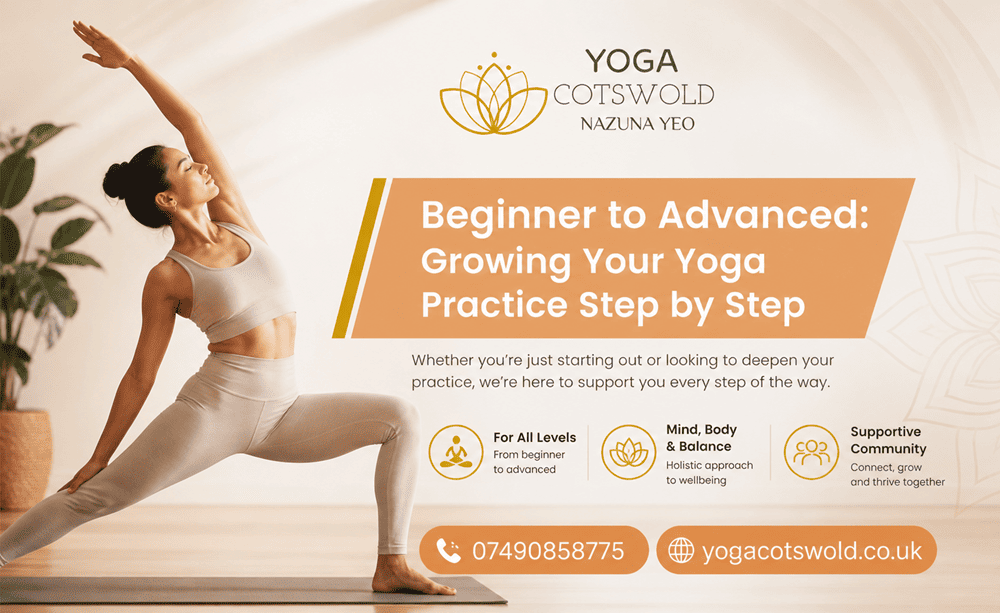
That there are multiple layers to developing your yoga practice and its not just about cultivating impressive shapes as quickly as possible! It is learning your body, finding your breath and beginning to be more truthful with yourself on the mat. Hi, I'm Nazuna yeo from yoga cotswold and to remind my students often that yoga does not expect you to turn up perfect. Instead it demands your presence.
Where Every Yogi Begins: The Beauty of Being a Complete Beginner
Every student remembers their first class. Some worry about touching their toes. Others fear they will look awkward, breathe loudly, or fall over in front of everyone. Honestly, we all wobble. I still wobble sometimes, and I teach for a living.
A beginner yoga practice begins with curiosity, not flexibility. When I first started teaching at Yoga Cotswold, I noticed that new students often apologised before the class had even started. “I’m not very good,” they would say. However, yoga is not a performance. It is a relationship with your body.
Of those who are looking for yoga for beginners uk the first step is often the most difficult; booking that first class. So, from the minute someone walks through the door, I try to make Yoga Cotswold calm and friendly, and sensitive to competition. You do not need fancy leggings, the ideal body, or a spiritual lexicon. Breath, patience and just the willingness to start.
More important than anything, that stage breeds humility. You learn to notice how your shoulders hold tension, how your hips resist movement and how your mind races at any sign of even stillness. Along the way, you find little wins: steadier breath, soft knees, relaxed jaw and the beautiful knowledge that your body is capable of changing.
So as an approach, Nazuna Yeo yoga teacher I offered the same for every new student: Start where you are not where you think you should be. That sentence sounds simple. But it can change the way you think of yoga altogether. Get details on Yoga Teacher in Leckhampton.
Yoga Fundamentals: The Building Blocks You Cannot Skip
Before you chase after complicated sequences, learn the yoga basics. This is often innate, the breath, your posture and awareness of body parts follow each other to build up without injury a proper reign over your yoga practice. They are the frame that holds my motions; without them, even the most functional gestures feel forced; with them even the simplest poses can open up and ground out.
The depth of your Yoga or the breathing i.e. pranayama is all there in Yog. It calms your nervous system, grounds you and helps you to move with precision. One example, inhale on four through the nose and exhale out for four. Simple? Yes. Easy under pressure? Not always.
On the other hand, alignment matters (not in a strict, military sense). Your body has its own history, So good alignment is just being in a position that supports your joints muscles and breath. On the other hand, learning how to deal with discomfort teaches you how to tell the difference between productive effort and warning pain. Looking for a Yoga Teacher in Pittville?
Mountain Pose (Tadasana)
Duration: Hold for 5–8 breaths
Stand up tall and place your feet about hip-width apart, weight evenly distributed between both soles. On your inhale, grow long from the crown of your head; on the exhale, release your shoulders out of your ears.
Tip for alignment: Do not lock the knees, as this can create tension through the low back.
Nazuna: “I like Mountain Pose because it looks quiet, but it really teaches you a lot about how to stand strong.”
Child’s Pose (Balasana)
Duration: Hold for 6–10 breaths
Knees on a mat, Big toes touching your big toes together, fold your body forward and reach out with both arms or place them near or next to you. On every outward breath, let your ribs and back release toward the floor.
Tip of alignment If you feel tightness in your hips, put a cushion or bolster between the area of your rig and calf.
Nazuna thinks: “Taking a break is not losing. I tell the students that Childs Pose can be one of the hardest things you do in class.
Downward-Facing Dog (Adho Mukha Svanasana)
Duration: Hold for 5–8 breaths
Start on hands and knees, tuck your toes, and lift your hips up and back. As you inhale, press through your palms; as you exhale, bend your knees slightly and lengthen your spine.
Alignment tip: Do not force your heels to the floor if it rounds your back.
Nazuna says: “This pose becomes kinder when you stop trying to make it look like a photograph.” Get details on Yoga Teacher in Prestbury.
The Intermediate Stage: Where the Real Growth Happens
The intermediate yoga degree can actually be completely mysterious. But you know enough to be able to see more and not enough to feel completely secure. The real learning lies in that messy middle.
By this time students frequently want to know how to move onto the next level in yoga as they are becoming frustrated that their initial progress with the practice has slowed down. Yoga gives all these instant rewards: you feel more balanced, your hamstrings are shorter, your sleep is calmer. But intermediate practice asks for more subtle development. You work towards fluidity, and breath control in some poses you have never expressed before, here you start to realize habits that were invisible.
In classes, I chunk this progression. First, we revisit foundations. Follow it up with strength, mobility, balance and breath steadiness. It may look a lot like wrist prep, core work, shoulder strengthening until we can experience the idea of leaning forwards before doing something incredibly risky like Crow Pose. Which in turn makes it so scary for students, as this is not a massive step into the void.
This stage also teaches patience. Your flexibility improves whilst the strength comes in fits and starts or your strength expands while your balance bounces like a lamb in spring. That is normal. Forcing both at once tends to result in the frustration of not knowing and not being able to go easy.
Yoga stages of learning rarely progress smoothly and in a straight line. Weeks are bright and easy; others, clumsy. However, those bumpy weeks contain a wealth of lessons. The intermediate stage will teach you to be curious not attached to results in growing your yoga practice.
Yoga Progression Tips: How to Move Forward Without Pushing Too Hard
Yoga appears with stability, not by drama. So the first rule is extremely simple: pick consistency over intensity. So much more often than not, your success comes from a singular calm practice of twenty minutes threex a week versus one glorious daring heroic two hour session followed by six days of stiffness.
Rest days matter too. Your muscles are repairing while you rest, as is your nervous system which needs room for new movement patterns to be absorbed. Consequently, rest is folded into training rather than breaking it. Sometimes, I tell students to think of rest as a quiet teacher.
Journalling can also support growth. Write three quick notes after practice — what was strong, what felt tight, and what was your breath saying to you? As his notes accumulate they reveal patterns. You may observe improved balance from better sleep or safer backbends following gentle hip work.
There is also a place for yoga self-practice and a place for guided teaching. At home, you develop independence and confidence. Meanwhile, a teacher can spot habits you cannot feel yet, such as gripping your jaw, collapsing into your shoulders, or rushing through transitions.
Plateaus deserve respect. They do not mean you have failed. Instead, they often show that your body is integrating. With this in mind, vary your routine gently. Add mobility work, slow down your breathing, revisit basics, or book a class at Yoga Cotswold for fresh eyes and encouragement. Looking for a Yoga Teacher in Stow-on-the-Wold?
Yoga Consistency: Why Showing Up Matters More Than How You Show Up
And the reason you can create change with yoga consistency is that your body trusts repetition. Not harsh repetition. Kind repetition. With a return to the mat, your muscle, joints, breath and mind become familiar with the rhythm.
From a philosophical standpoint as well, yoga appreciates the significance of steady practice. Feel inspired every other day. In fact, waiting for motivation is just an excuse in disguise. Focus on creating a practice that is small enough for you to maintain. Ten minutes counts. Five breaths count. Even a soft forward bend following a long day counts.
And for home, begin with a simple form: arrive, breathe, move, rest. Two minutes of breathing, five minutes of gentle stretches, ten minutes of standing poses and three minutes in stillness for example. This means you can create a reliable container without worrying about every little detail.
Short daily sessions and longer weekly sessions both have value. However, short practices often build stronger habits because they remove pressure. In addition, they teach you that yoga belongs in ordinary life, not only in perfect studio moments.
When growing your yoga practice, remember that showing up tired, distracted, or stiff still matters. Some of my most meaningful practices have looked deeply unimpressive from the outside. Yet inside, something softened. That, to me, is progress. Get details on Yoga Teacher in Northleach.
Advanced Yoga Poses: A Honest Look at What “Advanced” Really Means
Advanced yoga poses can appear glamorous and daredevil, yet advanced yoga is not so much about balancing on your head or twisting yourself into a pretzel shape. That will mean a much more honed sense of awareness, slow breath, emotional maturity, and the ability to halt oneself ahead of ego.
But obviously a difficult position helps. They develop strength, bravery, focus and confidence. Instead, they should be nurtured from a solid base rather than from a rushed outcome. At Yoga Cotswold I take you through this with advanced work, preparation and options laced with humour. Safe falling teaches you more than faking it until you make it.
Crow Pose (Bakasana)
Duration: Hold for 3–5 breaths
Begin in a low squat with your hands shoulder-width apart on the mat. Bend your elbows slightly, place your knees high on your upper arms, and inhale as you shift forward; then exhale and lift one foot, perhaps both.
Alignment tip: Keep looking slightly forward rather than dropping your head.
Nazuna says: “Crow taught me that courage often arrives one toe at a time.”
Wheel Pose (Urdhva Dhanurasana)
Duration: Hold for 3–5 breaths
Lie on your back, bend your knees, and place your feet close to your sitting bones. Place your hands beside your ears, inhale to prepare, then exhale as you press into hands and feet to lift your chest.
Alignment tip: Keep your feet parallel and avoid letting your knees splay wide.
Nazuna says: “Backbends ask for honesty, so I never rush students into Wheel before the shoulders and spine feel ready.”
Headstand (Sirsasana)
Duration: Hold for 3–8 steady breaths
Start on your forearms with your fingers interlaced and the crown of your head lightly placed on the mat. As you inhale, lift your hips; as you exhale, draw your lower belly in and walk your feet closer before lifting with control.
Alignment tip: Avoid dumping weight into the head; press strongly through the forearms.
Nazuna says: “Headstand is not a party trick. It is a lesson in calm strength and clear attention.” Looking for a Yoga Teacher in Moreton-in-Marsh?
Yoga Mindset: The Inner Journey That Runs Alongside the Physical One
That is where the deeper work starts, when you observe your reactions. Do you compete with the person next to you? Does that annoyance come around when your balance disappears? So, do you keep going even when your tiredness signals that it is too much?
Non-attachment is part of a healthy mature yoga mindset. You still practise and learn and grow, but you start to loosen your expectation of results. As a result, success is not about “doing” a pose anymore but probing who you are through the effort.
Patience also matters. Your body undergoes seasonal changes, stress changes, sleep changes, hormone changes, age changes and life changes. On the other hand, self-compassion makes the practice sustainable. Yoga is yet another place where you can feel judged if you speak to yourself harshly on the mat. That is not the point.
At Yoga Cotswold, I often guide students through mental blocks by asking them to soften their expectations for one round of breath. Just one. As a result, they feel what happens when effort and kindness work together. Nazuna Yeo’s teaching style centres on this balance: enough challenge to grow, enough gentleness to stay honest.
Building a Yoga Self-Practice: Making the Mat Your Own
A personal home practice does not have to be neat. Actually it works best when its related to real life too. Start with your energy level. Go for relaxing stretches, breathwork, rest if you are tired. Increased energy — Stand Poses, Balancing postures or a stronger flow if you feel in the mood.
People underestimate the positives props bring. Blocks bring the floor closer. Knees and hips are supported by a blanket. Using a strap assists you to access without excessive stretching. Stop seeing props as crutches for beginners, and see props as intelligent support.
Yoga Cotswold Classes Encourage at-home Practice We teach our students exactly how the poses feel, not just how they look! So for practice by yourself, you are doing it safer. With turning to listening as your practice, the mat starts to become less about following directions and more of a place where you turn up with presence.
Ultimately, to deepen your yoga practice is to make it personal. You still learn from teachers, but you start to trust your own breath body and rhythm.
Related Articles:
» Yoga for Flexibility: Split Training Without Overstretching
» Evening Yoga to Unwind: A Gentle Routine for Better Sleep
» Yoga Nidra for Deep Sleep: 20-Minute Script
» Yoga for Carpal Tunnel & Tight Forearms
» Starting Yoga Again After a Break: A Gentle 4-Week Plan
A Final Word from Nazuna Yeo
If you take one thing from this article, let it be this: you are allowed to grow slowly. Truly. Some days your practice will feel graceful, and other days your balance will vanish for no obvious reason. That does not mean you are going backwards.
When I teach at Yoga Cotswold, I see students change in quiet, beautiful ways. They stand taller. They breathe more fully. They stop apologising for being beginners. Over time, they begin to trust themselves.
So, whether you are starting your first class, exploring intermediate yoga, or looking at advanced yoga poses with nervous excitement, come back to the basics. Breathe. Listen. Practise kindly. Then practise again.
FAQs: Beginner to Advanced: Growing Your Yoga Practice Step by Step
1) I’ve never done yoga before — where should I honestly start?
Start with a gentle beginner class, a simple home routine, or a short one-to-one session if you feel nervous. However, do not start by comparing yourself with online videos of experienced practitioners. A good first step includes breathing, basic mobility, and a few grounding poses such as Mountain Pose, Child’s Pose, and Cat-Cow. At Yoga Cotswold, Nazuna Yeo helps new students learn slowly, with clear cues and no pressure to perform. Above all, begin with curiosity. Your first class does not need to be elegant; it only needs to be honest.
2) How long does it take to progress from beginner to intermediate yoga?
Most students notice beginner confidence within a few months of steady practice, although everyone moves at a different pace. For example, someone practising three times a week may build strength and body awareness faster than someone practising occasionally. However, progress also depends on sleep, stress, mobility, past injuries, and consistency. Intermediate yoga begins when you understand basic alignment, breathe steadily through movement, and modify poses without feeling discouraged. Rather than chasing a deadline, focus on steady learning. Growing your yoga practice works best when you measure progress by awareness, not speed.
3) Can I practise yoga at home without attending classes first?
Yes, you can practise at home, especially with simple poses and gentle breathing. However, attending classes first can help you understand safe alignment, useful modifications, and common mistakes. A teacher also helps you recognise when you are pushing too hard or avoiding helpful effort. If you begin alone, keep your routine short and simple. Choose beginner-friendly movements, avoid advanced inversions, and listen closely to your body. In addition, occasional guidance at Yoga Cotswold can give your home practice more confidence, structure, and safety.
4) What are the most important yoga poses for a complete beginner to learn?
A complete beginner benefits from learning Mountain Pose, Child’s Pose, Downward-Facing Dog, Cat-Cow, Low Lunge, Seated Forward Fold, and a simple resting pose. These poses teach grounding, spinal movement, breath awareness, hip mobility, and gentle strength. However, the “most important” pose often changes depending on your body. For example, someone with tight shoulders may need more supported chest opening, whilst someone with lower back tension may need gentle core work. Nazuna Yeo usually teaches yoga poses step by step so beginners understand the purpose behind each shape.
5) How do I know when I’m ready to move to an intermediate level?
You may feel ready for intermediate yoga when you can follow basic sequences without feeling lost, breathe steadily during effort, and understand how to modify poses. In addition, you should recognise the difference between challenge and pain. Readiness does not mean every beginner pose feels easy. Instead, it means you can practise with awareness and patience. If you feel curious about stronger flows, longer holds, or more detailed alignment work, speak with your teacher. At Yoga Cotswold, progression happens gradually, so students can explore the next stage without feeling thrown into the deep end.
6) Is there an age limit for progressing to more advanced yoga poses?
No fixed age limit exists, although your approach should suit your body, health, and experience. Many people develop impressive strength, balance, and mobility later in life. However, advanced practice may look different for each person. For one student, it may mean Crow Pose. For another, it may mean sitting comfortably with calm breath for ten minutes. If you have injuries, blood pressure concerns, glaucoma, or spinal issues, seek professional guidance before inversions or deep backbends. Advanced yoga should feel intelligent, not reckless. Your body deserves respect at every age.
7) How many times a week should I practise yoga to see real progress?
For most people, two to four sessions a week create noticeable progress. However, shorter daily sessions can work beautifully too. Ten minutes of mindful practice each morning may build more consistency than one intense weekly class. As a result, your body receives regular reminders without becoming overwhelmed. Mix class practice with home practice if possible. For example, attend Yoga Cotswold once or twice a week, then add short home sessions between classes. Progress comes from repetition, rest, and attention. It does not come from punishing yourself into flexibility.
8) What should I do when I hit a plateau in my yoga practice?
First, do not panic. Plateaus happen to everyone, including teachers. Sometimes your body needs time to integrate strength, mobility, and coordination. However, a plateau can also signal that you need variety. Try slowing down, adding props, revisiting foundations, journalling your practice, or working with a teacher for fresh feedback. In addition, look beyond physical progress. Is your breath calmer? Are you more patient? Do you recover from stress faster? Those changes count. Growing your yoga practice often includes quiet progress that does not announce itself loudly.
9) Do I need to be flexible to start yoga — or does yoga make you flexible?
You do not need to be flexible to start yoga. That idea puts far too many people off. Yoga can improve flexibility over time, but it also builds strength, balance, breath awareness, and calm focus. In fact, very flexible people sometimes need to learn stability before stretching further. If you feel stiff, yoga may help you move with more ease. However, the goal is not to force your body into dramatic shapes. Instead, practise regularly, breathe well, and let flexibility develop naturally. Your starting point is welcome.
10) How does Nazuna Yeo’s teaching approach differ from a standard yoga class?
Nazuna Yeo teaches with warmth, detail, and a strong respect for individual bodies. Rather than pushing everyone towards the same version of a pose, she offers options and encourages students to listen carefully. Her classes at Yoga Cotswold blend practical alignment, breath awareness, gentle humour, and thoughtful progression. As a result, students feel supported rather than judged. She also explains why movements matter, which helps students build confidence beyond the studio. The aim is not simply to copy shapes. It is to understand your body and practise with kindness.
11) What classes does Yoga Cotswold offer for different levels of experience?
Yoga Cotswold supports students at different stages, from complete beginners to those exploring stronger and more advanced work. Beginner-friendly classes usually focus on foundations, breath, alignment, and confidence. Meanwhile, intermediate sessions may include longer holds, flowing transitions, strength work, and deeper mobility. Advanced options can introduce challenging poses with careful preparation and modifications. If you feel unsure which class suits you, choose the gentler option first. Then speak with Nazuna Yeo about your goals, injuries, and experience. A good class should challenge you without making you feel unsafe.
12) How do I stay motivated when my yoga progress feels slow?
Motivation grows when you notice small wins. Therefore, track more than flexibility. Notice better sleep, steadier breathing, improved posture, calmer reactions, and less tension in your shoulders. In addition, keep your practice realistic. A routine that fits your life will outlast a perfect plan that exhausts you. Practise with others when you need encouragement, and return to self-practice when you need quiet. Above all, remember that slow progress is still progress. Yoga is not a race across the mat; it is a long friendship with your body.
Contact
info@yogacotswold.co.uk
Social Media
Get in Touch
07490858775




Address: GEORGE MOORE COMMUNITY CENTRE- BOURTON ON THE WATER
Moore Road, Bourton on the Water GL54 2AZ