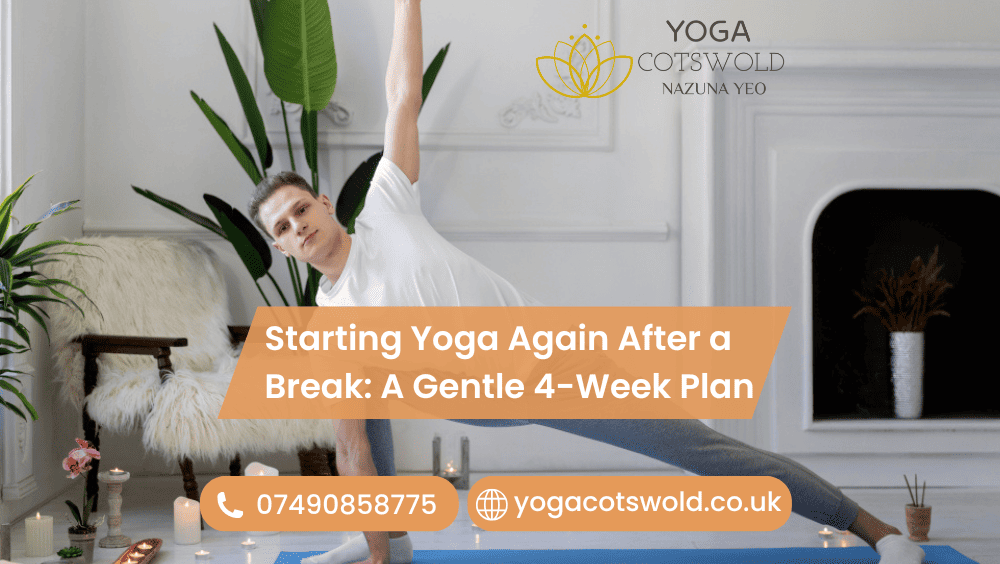
Starting Yoga Again After a Break: A Gentle 4-Week Plan
Restart yoga confidently with our gentle 4-week plan. Ease back into practice, rebuild strength, improve flexibility & boost mindfulness.
HEALTH TIPS
1/16/20266 min read
If you’ve fallen out of the habit with yoga, don’t worry — it’s not just you. It can be for all sorts of reasons — you’re busy with work, life stuff comes up, you travel or get sick or just fall out of the habit. And then one day you're faced with your mat and like, “OK… what? WHERE do I even begin?”
The thing is: coming home doesn’t have to mean a big production. You don’t have to dive right into long flows or act as if you never took a break. In fact, the gentlest return is often what will stick.
At YOGA COTSWOLD, teacher NAZUNA YEO often reminds students that restarting is less about “getting back” and more about meeting your body where it is today. So, if you want a plan that’s calm, realistic, and not full of pressure, this 4-week gentle yoga plan is for you.
Along the way I’ll be emphasizing yoga following a break, consistency and feeling better in your body—without guilt, without “all or nothing.”
First, reset your expectations (and make it easier than you think)
Let’s not sugarcoat it: those initial sessions can be a little… awkward. It’s likely to feel stuck, your wrists will whine, you’ll teeter on balance and your brain may begin comparing yourself to “old you.”. However, that comparison game is the quickest way to make yoga feel like a chore.
Instead, try this:
Pick a “minimum practice” you can do even on low-energy days. Make it 10 minutes.
Leave your mat out if you can. Out of sight really does become out of mind.
Use props like they’re normal (because they are). A cushion and a blanket can change everything.
Aim for steady, not perfect. Some days will feel good. Others won’t. That’s still progress.
A quick safety note (the boring bit, but important)
If you’ve recently had surgery, if you’re dealing with a major injury or if you get sharp pain with certain movements, it could be wise to check in first with a health care provider. Also — this is important: If a pose causes sharp, pinchy pain, don’t power through it. Discomfort is one thing. Pain is another.
How the 4-week plan works
This plan builds in small steps. That means Week 1 is very gentle, Week 2 turns up the dial just a little bit in terms of structure, Week 3 brings in some soft flow, and then it continues to help you establish lodging that sticks.
Frequency: 4–6 days per week
Time: 10–30 minutes
Intensity: gentle → steady → gently stronger → confident and calm
Goal: feel better, move easier, breathe deeper
You can practice this at home in your own time, or use it as a complement to sessions with NAZUNA YEO at YOGA COTSWOLD if you would appreciate some support and personal adjustments. Get details on Yoga Teacher in Leckhampton.
Week 1: Start with breath, comfort, and simple movement
Aim: loosen up and feel safe in your body again.
Practice time: 10–15 minutes.
Days: 4–6 days.
In Week 1, you’re basically saying, “Hello body, I’m back, and I’m not here to fight you.” So keep it slow. Keep it kind.
Week 1 mini-practice (10–15 minutes)
Easy Seat + breathing (2 minutes)
Inhale for 4, exhale for 6. If that feels too long, shorten it. No big deal.Shoulder rolls + neck release (1–2 minutes)
Small circles. Try not to crank your neck.Cat–Cow (2 minutes)
Breathe in as you lift the chest, breathe out as you round. Let the movement follow the breath.Child’s Pose (2 minutes)
Place a cushion under your belly or forehead if it helps. Make it cosy.Low lunge (1 minute each side)
Back knee down. Hands on blocks or a chair if needed.Supine twist (1 minute each side)
Keep it gentle. Let the shoulders soften.Legs up the wall (2–3 minutes)
Or calves on a chair. Both count.
Nazuna-style cue: try making your exhale slightly longer than your inhale. It calms the nervous system fast, especially if you’re coming back stressed or tense. Looking for a Yoga Teacher in Pittville?
Week 2: Build rhythm and light strength (without going too hard)
Aim: create a routine and strengthen the basics.
Practice time: 15–20 minutes.
Days: 4–6 days.
Week 2 is where you start feeling that “oh yes, I remember this” moment. Still, it’s also where people can accidentally overdo it. So, stay calm and keep the ego out of it.
Week 2 practice template (15–20 minutes)
Breathing (2 minutes)
Inhale 4, exhale 6 (or your own comfortable count).Warm-up (5 minutes)
Cat–Cow, Thread the Needle, then a gentle Down Dog with knees bent.Standing foundations (8–10 minutes)
Mountain Pose: feel your feet properly
Half Sun Salutations: hands to thighs, maybe hands to blocks
Warrior I: shorter stance, find stability
Warrior II: soften shoulders, soften jaw (yes, really)
Cool-down (3–5 minutes)
Gentle Bridge or reclined stretches, then Savasana (even if it’s only a minute).
Progress check: you should finish feeling clearer, not exhausted. If you’re wiped out afterwards, reduce the standing part and add more floor-based movement. Looking for a Yoga Teacher in Prestbury?
Week 3: Add a slow flow, but keep it friendly
Aim: build stamina and ease, without burning out.
Practice time: 20–25 minutes.
Days: 4–5 days.
By Week 3, your body usually feels a bit more “awake”. Great. Now the challenge is not turning it into a bootcamp. Slow, steady, and breathable is the vibe.
Week 3 gentle flow (20–25 minutes)
Breath + intention (2 minutes)
Something simple like: “I’m here to feel better.”Warm-up (5 minutes)
Cat–Cow → Low Lunge → Down Dog (knees soft).Slow flow (10–12 minutes)
Half Sun Salutation x 3
Lunge → Crescent (knee soft, ribs not flared)
Chair Pose (short hold, 2–3 breaths only)
Tree Pose (foot to ankle or calf, not the knee)
Hips + hamstrings (4–5 minutes)
Figure-4 stretch
Supported forward fold (bend knees a lot… seriously)
Rest (2–3 minutes)
Savasana or Legs up the Wall.
Nazuna reminder: if your breathing gets choppy, you’re going too fast. Slow down until the breath smooths out again.
Week 4: Choose your style, keep it sustainable
Aim: establish a routine you can really maintain when the four weeks are up.
Practice time: 25–30 minutes.
Days: 4–6 days.
Week 4 is where you stop “returning” and start “practising”. That’s a big shift. Now you can choose what you need day by day—calm or steady, stretch or strength. Get details on Yoga Teacher in Stow-on-the-Wold.
Option A: Calm and grounded (25–30 minutes)
Breathwork
Longer holds: Child’s Pose, Low Lunge, supported Pigeon, Supine twist
Longer Savasana (even 5 minutes makes a difference)
Option B: Steady and strong (25–30 minutes)
Gentle Sun Salutations
Warrior series
Side Angle (hand to block)
Bridge pose or short plank holds (no heroics)
Proper cool-down and rest
Progress check: you can have an easier time with your posture, better sleep, less tension in your hips or a more stable mood. These are actually big, “small” things.
Related Articles:
» Yoga for Arthritis: Joint-Safe Movement You’ll Enjoy
» 7 Powerful Ways Yoga Helps You Sleep Better
» Why Yoga Is the Best Natural Remedy for Joint Pain?
» Can Yoga Improve Digestion and Gut Health?
» Can Yoga Help You Sleep Better?
The most common mistakes when restarting yoga (and what to do instead)
Mistake: going straight back to advanced poses.
Do this instead: rebuild mobility and stability first.Mistake: practising only when you feel motivated.
Do this instead: practise when you’re unsure—just your 10-minute minimum.Mistake: forcing stretches to “get flexible again”.
Do this instead: take it slow, breathe deep and allow mobility and flexibility to come back on its own.Mistake: treating rest like it doesn’t count.
Do this instead: treat rest as part of yoga. Because it is.
Practise with Nazuna Yeo at YOGA COTSWOLD
If you want a supportive restart with real guidance, practising with NAZUNA YEO at YOGA COTSWOLD can help you adapt everything—especially if you’re stiff, anxious about returning, or unsure what’s “too much”. Having a teacher’s eye can make it feel safer and more enjoyable from day one.
FAQson "Starting Yoga Again After a Break"
1) How long should I practise if I’m starting yoga again?
Work up to 20–30 minutes then build to 20–30 henarius once your body feels in control.
2) How many days a week is best?
Aim for 4–6 days. Consistency beats intensity every time.
3) What if I’m really stiff after my break?
Normal. Bend your knees, use props and perform gentle mobility work first.
4) Can I do yoga every day?
If we are on a light day, then yes. Also, if you are feeling depleted, take a rest day.
5) Morning yoga or evening yoga—what’s better?
Just as morning is about routine, so does evening signal relaxation. Choose what fits your life.
6) Do I need to be fit to restart?
No. Beginner-friendly yoga encourages you to slowly rebuild strength and confidence.
7) What props help most?
A cushion, blanket and two blocks (or firm books) are a good go.
8) How do I know I’m pushing too hard?
If your breath becomes strained, if pain emerges or you feel worse afterward — scale back.
9) What style is best when returning?
Begin with gentle yoga or restorative yoga, and then introduce slow flow once comfortable.
10) What if Downward Dog doesn’t feel good?
Modify it: bent knees, hands on blocks, or swap to Child’s Pose. It still counts.
11) How soon will I feel progress?
Some notice changes in 2–3 weeks, especially if practised regularly.
12) Can a teacher help me restart safely?
Absolutely. A teacher like NAZUNA YEO can tailor pace, alignment, and options.
Contact
info@yogacotswold.co.uk
Social Media
Get in Touch
07490858775








Address: GEORGE MOORE COMMUNITY CENTRE- BOURTON ON THE WATER
Moore Road, Bourton on the Water GL54 2AZ