
Yoga for Shift Workers: Sleep, Meal Timing, and Mini-Flows
Struggling with night shifts or rotating schedules? Discover yoga for shift workers, including sleep support, smart meal timing, and mini-flows.
HEALTH TIPS
3/3/20266 min read
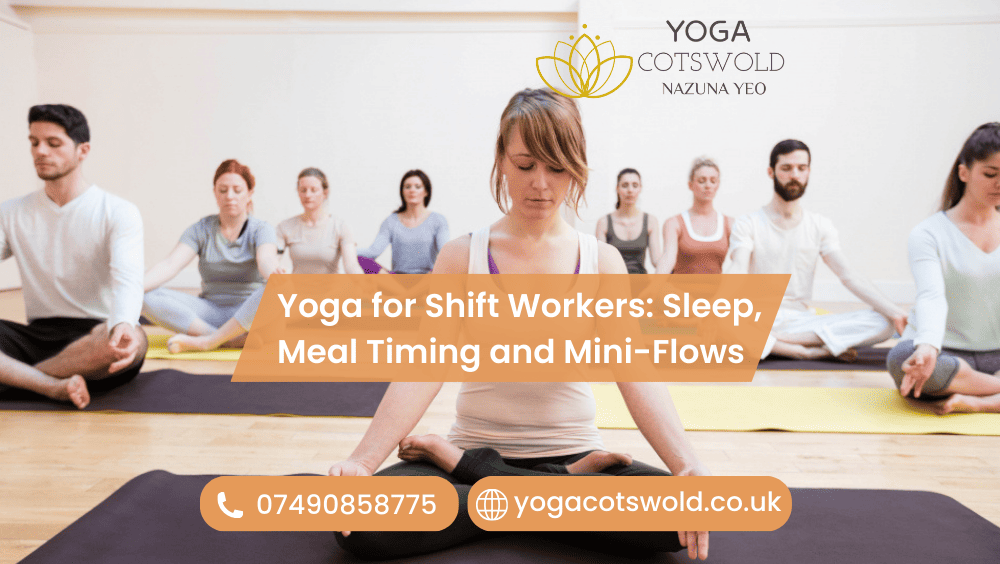
If you wait tables, you know the feeling: You finally lie down, and your brain is like wide awake. Or you wake up in the middle of some odd hour, hungry but not hungry, tired but not sleepy and vaguely uncertain what day it is. You’re not just being “bad” at resting: shift work truly drags your body clock around.
I’m Nazuna Yeo, a yoga teacher at YOGA COTSWOLD, and I’ve taught plenty of people who juggle nights, rotating rotas, early starts, and those awkward “finish late, back early” turnarounds. The pattern is usually the same: sleep becomes patchy, meals happen whenever there’s a gap, and your body holds tension because it never fully switches off.
This article is a guide to its practical application — not overly mystical, and nothing requiring an hour on the mat every day. We’ll hone in on three things that shift workers really need: sleep support, meal timing and short, realistic mini-flows that you can crank out in a few minutes.
Why shift work messes with sleep
Your body likes rhythm. Light, darkness, movement and food all work like signals that help calibrate your system as to what time it is. Shift work scrambles those signals.
So when you’re attempting to sleep during the day, your body may remain in “day mode.” Then when you need to be awake after dark, your energy drops about three hours before bedtime because your body expects rest. Add stress, screens, caffeine and bright lighting at work, and it’s no surprise sleep can feel like a struggle.
Yoga doesn’t magically “fix” shift work. Still, it does something very useful: it gives your body predictable cues. Even when your rota changes, a short routine can become a familiar message—we’re winding down now or we’re waking up now. Get details on Yoga Teacher in Swindon Village.
A shift-worker sleep routine that’s actually doable
1) Choose an “anchor” routine, not a perfect bedtime
But if your bedtime varies, go for a repeatable wind-down instead. Your body can learn patterns faster than it can learn clock times.
Try this: find one short set of exercises you do before sleep(don’t worry if that sleep is 9am!) This should be left unchanged for a couple of weeks. It doesn’t have to be long. Consistency is the win.
2) Keep it gentle when you’re tired
When settling in on too little sleep, vigorous yoga can feel like too much. Gentler poses and slower breathing will be the ticket on those days. Think: relieving tension, loosening the jaw, easing the belly.
3) A 6-minute wind-down (no kit needed)
Do this right before bed:
Child’s Pose — 1 minute
Let your forehead rest, breathe into your back ribs.Thread the Needle — 30 seconds each side
Soften shoulders and upper back.Legs Up the Wall — 3 minutes
Let your legs feel heavy, unclench your hands.Supine Twist — 30 seconds each side
Keep it easy; this is not a stretch competition.
Light and caffeine: small changes that help your yoga work better
Yoga works best when your daily habits don’t fight it.
If, say after a night shift, try to minimise bright light exposure when going home (yea, even sunglasses can help
Get some light and movement in before a night shift to let your body know it’s time for alertness.
Caffeine is a lot more personal, but as a good general rule of thumb: Don’t have it too near your intended sleep window. Even if you “can sleep after coffee”, your sleep quality usually is compromised.
No judgement here—shift work is demanding. These are just small levers you can pull. Looking for a Yoga Teacher in Andoversford?
Meal timing for shift workers: steady fuel, calmer sleep
Food timing can make your sleep better or worse. It can also impact your mood more than you realise. When you’re fatigued, the body frequently solicits quick fuel — typically sugar or hyper-processed snacks. That’s not a personal failing; it’s biology.
Instead of trying to eat perfectly, aim to eat predictably.
1) Eat a proper meal before your shift
Try and get a good meal before you crack on with work if you can. It’s lighter than heavy food at 2am, easier on digestion, and helps avoid constant grazing.
A simple plate works well:
protein (eggs, chicken, tofu, yoghurt)
fibre (veg, salad, beans)
some carbs (rice, potatoes, pasta, oats)
and something with healthy fat (olive oil, nuts, avocado)
2) During the shift, choose “steady snacks”
Go for snacks that won’t spike and crash you:
fruit + nut butter
yoghurt + granola
hummus + crackers
soup
nuts and a piece of fruit
a sandwich with protein
3) After a night shift, keep food light before bed
If you’re starving after work, eat a small snack. Eat a big meal just before you go to bed, and you’ll be fitful.” Porridge toast, banana or simple soup tend to feel better in the body.
Yoga helps here, as it increases your awareness of what your body actually needs. With practice, you can distinguish “I’m really hungry” from “I’m wired and seeking comfort.” Get details on Yoga Teacher in Moreton-in-Marsh.
Mini-flows: short yoga that fits into shift life
You don’t require a whole class each time. The best practice, the ideal one, is the one you’re most likely to implement during an actual week.
Mini-flow 1: Pre-shift wake-up (4 minutes)
Great before an early shift or when you feel stiff.
Cat–Cow — 45 seconds
Low Lunge — 45 seconds each side
Downward Dog — 45 seconds
Forward Fold — 45 seconds
Mountain Pose — 30 seconds, slow breathing
This wakes up your spine and hips without draining you.
Mini-flow 2: Mid-shift tension release (5 minutes)
Perfect on a break—especially if you’re on your feet or at a desk.
Neck stretch — 30 seconds each side
Shoulder rolls — 30 seconds
Standing chest opener — 45 seconds
Ragdoll Fold — 1 minute
Standing twist — 45 seconds each side
If you do nothing else, do the ragdoll fold and breathe. It’s surprisingly effective.
Mini-flow 3: Post-night shift calm-down (7 minutes)
Use after work to help your body step out of “work mode”.
Seated Forward Fold — 1 minute
Reclined Bound Angle — 2 minutes
Legs Up the Wall — 3 minutes
Hand on belly, slow breathing — 1 minute
Keep it gentle. Your goal is calm, not flexibility. Looking for a Yoga Teacher in Northleach?
Two breath practices: one for sleep, one for focus
For sleep (2–3 minutes)
Longer exhale breathing
Inhale for 4, exhale for 6–8.
Keep it soft. If you feel breathless, shorten the exhale slightly.
For focus before a shift (1–2 minutes)
Steady energising breath
Inhale for 4, exhale for 4, slightly stronger rhythm.
Stop if you feel dizzy—steady is the aim.
Related Articles:
» Yoga for Lower Back Pain: A 15-Minute Daily Sequence
» Yoga for Swimmers: Shoulder Stability & Breath Control
» Yoga for Arthritis: Joint-Safe Movement You’ll Enjoy
» Morning Yoga for Beginners: 10-Minute Wake-Up Flow
» Yoga for Glutes and Hips: Build Strength Without Bulking
A simple routine you can stick to
If your rota is unpredictable, don’t build a complicated plan. Choose:
one mini-flow before work (3–5 minutes)
one wind-down after work (5–8 minutes)
one breath practice (2 minutes)
At YOGA COTSWOLD, I’d rather you do seven minutes three times a week than attempt a perfect routine and give up. Shift workers need flexibility and kindness, not pressure.
FAQs: Yoga for Shift Workers
1) What’s the best yoga for shift workers?
Gentle flow, restorative poses and short mobility-focused routines tend to be the most realistic and helpful.
2) Can yoga help with shift work sleep problems?
Yes, it can support relaxation and reduce stress so sleep becomes easier and deeper over time.
3) Should I do yoga after a night shift?
Yes—keep it calming (legs up the wall, twists, gentle forward folds) to help your body wind down.
4) How long should my practice be?
If you practice consistently, even 3–10 minutes can be a significant difference
5) What if I’m too tired for yoga?
Do restorative poses and breathing. Lie down, place your legs up the wall and inhale deeply.
6) Can yoga help with stress eating on shifts?
It can, because it increases body awareness and you start to notice what cravings feel like compared to actual hunger.
7) What should I eat before a night shift?
Nothing like a balanced meal before you go: protein + fibre + some carbs to carry that energy across.
8) Should I eat after a night shift before sleeping?
If you have to eat, then eat simple and light. Heavy meals can disrupt sleep.
9) What’s the best pose for tired legs after a long shift?
Legs Up the Wall is brilliant—simple, calming, and supportive.
10) I get tight shoulders and neck pain—what helps?
Thread the Needle, openers for the chest and stretches for the neck combined with slow breathing can help release that tension.
Contact
info@yogacotswold.co.uk
Social Media
Get in Touch
07490858775








Address: GEORGE MOORE COMMUNITY CENTRE- BOURTON ON THE WATER
Moore Road, Bourton on the Water GL54 2AZ