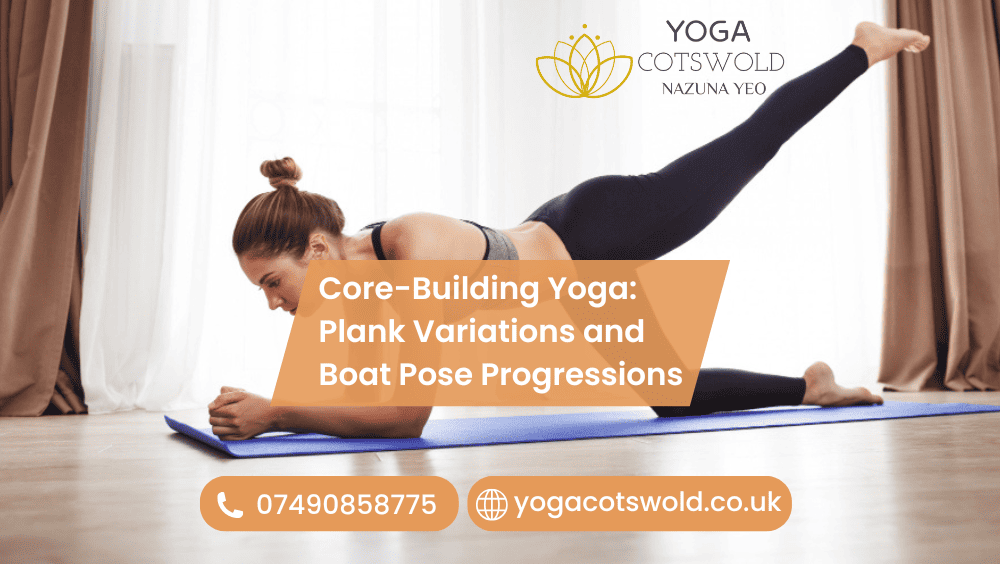
Core-Building Yoga: Plank Variations and Boat Pose Progressions
Build strength and stability with core-building yoga. Practice plank variations and boat pose progressions to tone abs & improve balance.
HEALTH TIPS
2/24/20265 min read
If you’ve ever done a plank and felt your whole body tremble, wondering, why is this so hard?, you’re not alone. The reality is, core-building yoga is so much more than “abs”. Your core actually comprises deep stabilisers around your waist, spine and hips – even the muscles that assist with healthy breathing. That’s why moves like plank variations and Boat Pose progressions are so challenging — but also some of the most effective tools for developing true, useable strength.
At YOGA COTSWOLD, teacher Nazuna Yeo is almost nagging students: strength comes from alignment first, effort second. So, rather than pushing for longer holds we’ll emphasize better technique, clearer breath and step-by-step progress. The result: You’ll create stability for everything from backbends like camel to posture in everyday life.
Why plank and boat are brilliant for core strength
Plank helps you build the ability to engage your entire body into a single straight line. Boat Pose meanwhile challenges your core differently, maintaining the length of the spine while resisting gravity. Together, they train:
Deep core stability (transverse abdominis and pelvic floor)
Shoulder and upper-back strength (key for safe arm balances)
Hip flexor control (often overworking in boat—so we balance it)
Postural endurance (less slumping at desks and during travel)
Most importantly, both poses reveal habits. You might dump into the shoulders in a plank, or round out the lower back in a boat, for example. But once you see these patterns, you can change them. Get details on Yoga Teacher in Leckhampton.
Your form checklist before you start
Before the “hard” stuff, set a strong base. This alone makes your plank variations and Boat Pose feel more stable.
In plank:
Hands shoulder-width, fingers spread, index knuckle rooted.
Shoulder blades broad, chest gently lifting (not collapsing).
Ribs knit in (avoid flaring), belly gently drawing back.
Heels press back, legs active, glutes lightly engaged.
In boat:
Sit on the front edge of your sitting bones (not slumping back).
Lift through the chest, lengthen the spine.
Keep your lower belly toned, but let the breath move.
Think “long and light” rather than “tight and clenched”.
If you feel wrist pain in the plank, try using fists, a wedge, or forearms. If your lower back aches in the boat, reduce the lever (bend knees) and lift the chest more.
Warm-up flow (5–7 minutes)
Do this before your main set. It wakes up the right muscles, and it also reduces strain.
Cat–Cow (6–8 rounds), then neutral spine
Bird Dog (5 each side), slow and steady
Downward Dog to Plank waves (4–6 times)
Low Lunge with gentle twist (3 breaths each side)
Forearm Plank preparation (20–30 seconds)
Now you’re ready. Looking for a Yoga Teacher in Pittville?
Plank variations that build strength without wrecking your shoulders
1) High Plank (foundation hold)
Hold High Plank 20–40 seconds. Rather than sinking or collapsing, push down into the floor. Then breathe, evenly — because if you can’t breathe, you’re squeezing.
Make it easier: knees down, keep a straight line from knees to crown.
Make it stronger: shift slightly forward (shoulders just past wrists) without sinking.
2) Forearm Plank (deep-core focus)
Lower to forearms, elbows under shoulders. This variation often reveals rib flare. So, exhale fully and gently draw the front ribs down.
Tip: press forearms into the mat as if dragging it back (even though it won’t move). That turns on the core and lats.
3) Knee-to-nose plank (control + compression)
From High Plank, exhale knee to nose, rounding slightly while keeping shoulders steady. Inhale back to plank.
Do 6–10 reps each side.
Why it works: it trains core control while your shoulders stabilise—perfect prep for stronger boat work too.
4) Side Plank (obliques + shoulder stability)
From plank, roll to the outer edge of one foot, stack shoulders and hips. Keep the bottom arm strong, chest open.
Hold 15–30 seconds each side.
Option: bottom knee down for stability.
Progression: lift top leg (Star Pose) for advanced core-building yoga work.
5) Dolphin Plank (forearm + shoulder challenge)
From the Forearm Plank, walk feet a tiny bit closer and lift hips slightly (not a full dolphin). Then return to the forearm plank.
Do 6–8 slow pulses.
This builds endurance while protecting wrists. Get details on Yoga Teacher in Prestbury.
Boat Pose progressions that actually feel achievable
Step 1: Supported Half Boat (knees bent)
Sit tall, hold behind your thighs, and lift your feet lightly. Keep shins roughly parallel to the floor if possible.
Hold 3–5 breaths.
Key point: lift the chest. If you round, you’ll feel it in hip flexors and lower back. However, when you lengthen up, the core can do its job.
Step 2: Low Boat taps (control training)
From bent-knee boat, inhale, then exhale lower back slightly (not collapsing) and tap heels down. Inhale lift back up.
Do 6–10 reps.
This trains stability without forcing a long static hold.
Step 3: Classic Boat Pose (Navasana)
Extend legs as much as you can while staying tall. Arms reach forward, shoulders relaxed.
Hold 3–5 breaths.
Important: it’s better to bend knees and keep spine long than straighten legs and slump.
Step 4: Boat “pulse” progressions
Try one of these:
Boat to Half Boat: extend legs a bit, then bend again (8 reps)
Twisting Boat: hands at heart, rotate gently side to side (6 each side)
One-leg boat: one leg extends, other stays bent (3 breaths each side)
Step 5: Low Boat (Ardha Navasana) — optional advanced
As you bend over, tuck your chest and legs in, yet elongate your lower straight back. It’s powerful, so take it easy: 2–3 breaths only.
If you feel your back gripping, stop and return to the bent-knee boat. Looking for a Yoga Teacher in Stow-on-the-Wold?
A 12-minute core sequence (Nazuna-style: steady > sweaty)
Repeat this circuit 2 times:
High Plank – 30 seconds
Knee-to-nose plank – 8 each side
Side Plank – 20 seconds each side
Forearm Plank – 30 seconds
Bent-knee Boat – 5 breaths
Boat taps – 8 reps
Classic Boat – 3–5 breaths
Rest in Child’s Pose – 3 breaths
Then complete the sequence with a twist and forward bend to stretch hip flexors.
Related Articles:
» Yoga for Flexibility: Split Training Without Overstretching
» Yoga for Seasonal Blues: Light, Breath, and Movement
» Yoga for Carpal Tunnel & Tight Forearms
» Starting Yoga Again After a Break: A Gentle 4-Week Plan
» Morning Yoga for Beginners: 10-Minute Wake-Up Flow
Common mistakes (and quick fixes)
Ribs flaring in plank → exhale, knit ribs down, soften the chest.
Shoulders collapsing → push the floor away, spread shoulder blades.
Lower back pain in boat → bend knees, lift chest, hold behind thighs.
Neck tension → keep gaze soft, lengthen back of neck, unclench jaw.
Holding breath → use a slow exhale; it switches on deeper core support.
FAQs on "Core-Building Yoga: Plank Variations & Boat Pose Progressions"
1) How often should I practise core-building yoga?
2–4 times per week works well. However, keep sessions short and consistent.
2) Is plank better than sit-ups for core strength?
For a lot of folks: yes — plank is so much better at teaching whole body stability and spares the neck from being crunched over and over again.
3) Why do my wrists hurt in plank?
It’s usually a matter of weight distribution or tight forearms. Use fists instead or put a folded towel under the heel of the hand.
4) Why do my shoulders burn first in plank?
You may be sinking into the shoulder joints. Push the floor away and broaden the upper back.
4) Why do my shoulders burn first in plank?
You may be sinking into the shoulder joints. Push the floor away and broaden the upper back.
5) What if I can’t hold a plank for long?
Perform 10-20 second holds with perfect form and repeat. Quality builds endurance faster.
6) Boat Pose hurts my lower back—what should I do?
Then bend the knees, holding behind the thighs to lift the chest. If necessary, the toes can be kept on the floor until stability is established.
7) Why do my hip flexors dominate in Boat Pose?
Usually the spine rounds and the pelvis tips back. Sit taller and reduce the leg extension to re-balance the effort.
8) Can beginners do Boat Pose progressions?
Absolutely. Start with supported half boats and heel taps. Progress gradually.
9) Should I do forearm plank or high plank first?
Either works. Many students find high plank helps alignment; forearm plank then deepens the core challenge.
10) How do I breathe in plank and boat?
Breathe wide into the lungs through the ribs, exhale long and deep. The long exhale can also contribute to increased stability right out of the gate.
Contact
info@yogacotswold.co.uk
Social Media
Get in Touch
07490858775






Address: GEORGE MOORE COMMUNITY CENTRE- BOURTON ON THE WATER
Moore Road, Bourton on the Water GL54 2AZ