Yoga vs Pilates: Which Is Better for Core Strength?
Yoga and Pilates both build strong core muscles. Pilates targets deep abdominal strength and posture, while Yoga improves balance and flexibility.
HEALTH TIPS
4/1/20266 min read
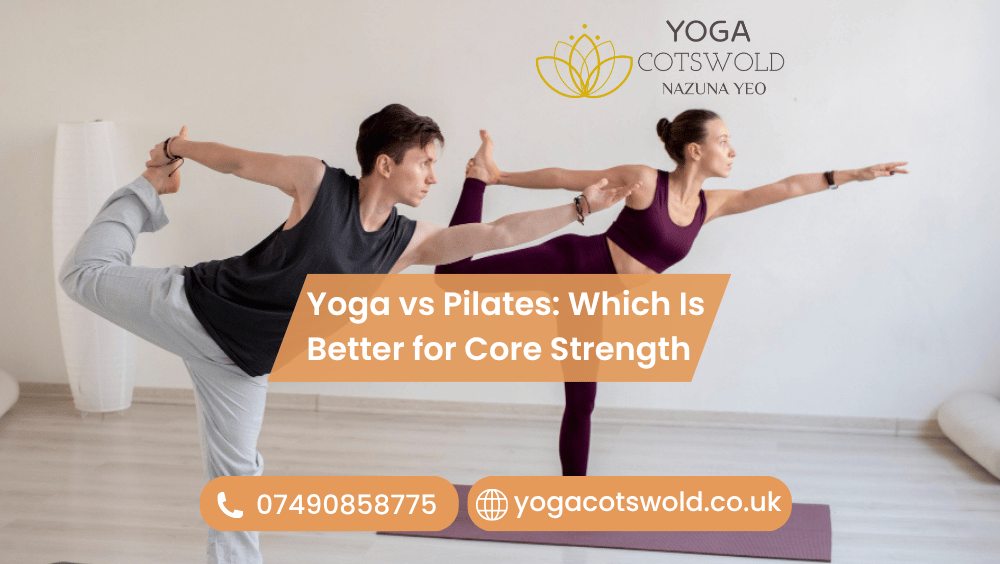
Yoga and Pilates are frequently contrasted with exercise plans for those who seek a stronger middle, better posture and greater control in daily movement. These two methods help the body in different ways, and both can yield better balance, flexibility and strength.
Teacher NAZUNA YEO at YOGA COTSWOLD frequently tells clients that the answer depends on your body, your goals and how you like to move. Yoga is for some a mindful way to flow through bouts of core strengthening while others love the exact structure and control offered by every Pilates exercise. Still, both practices provide real benefits, and neither is a bad choice.
Understanding Core Strength First
Before we compare the two it helps to baseline what core strength means. Your core is more than just stomach muscles. It engages the deeper musculature of your abdomen, lower back, hips, pelvis and even glutes. These muscles help when it comes to spinal support, improve your posture and aid in overall stability of movement.
A strong core can help with:
Better posture
Improved balance
Reduced lower back strain
Safer lifting and twisting
Greater control during exercise
More support in everyday movements
So when we see Yoga vs Pilates, we are actually inquiring as to which Practice makes greater and more sustainable physical gains in these muscles. Get details on Yoga Teacher in Leckhampton.
What Yoga Does for Core Strength
Yoga strengthens the body by holding postures, controlled breathing and sustaining awareness in the body. There’s a widespread belief that yoga is just about stretching, but that leaves out the whole story. Indeed, many of the poses require the deep abdominal muscles to engage and help stabilize the body.
Plank pose, boat pose, side plank, warrior III and chair pose are all core-challenging poses. Transitions between poses train coordination and control as well. Over time, Yoga can improve elements beyond muscle tone—many people find the practice makes them more aligned and enhances endurance, too.
Another benefit is that yoga works the body in its entirety. Rather than isolating the abdominals, it instructs the core to connect with the shoulders, hip joints and legs. As a consequence, the power that you develop generally seems much more all-natural and also functional.
What Pilates Does for Core Strength
The principle at the center of the Pilates method is core control. In many Pilates classes, core activation is built into almost every exercise. That is usually how it becomes the easier path when you are discussing something like core strengthening exercises.
Pilates emphasizes small, precise movements. These maneuvers engage the lower layer of deep abdominal musculature, known as the transverse abdominis, which serves as a sort of natural support belt around your torso. Exercises like the hundred, leg circles, roll-ups and single-leg stretch do a very specific preparation for those at the gym with their core.”
That kind of targeted tilt also serves to make for hardcore Pilates-for-the-core, even when (at least conspicuously) it’s uncomplicated. You may not be leaping or chugging sweat, but your muscles are working over time for the duration of it. Looking for a Yoga Teacher in Pittville?
Yoga vs Pilates: The Main Difference
The functionality of these two forms of exercise is the primary factor that distinguishes them. Yoga is strength and flexibility, breath and mind focus. Pilates is more focused on isolating muscles, particularly around the core.
So if you are asking which is better in terms of core strength alone, Pilates often gets the nod purely because that’s one of its primary goals. As precision instruments for isolating and strengthening the core, these movements are exceptional.
But that doesn’t make yoga any less potent. Yoga, in many world schools of thought, offers a more holistic practice. It also increases flexibility, mobility and calmness while strengthening the core. For some, that larger benefit creates a better fit with yoga.
Which Is Better for Beginners?
Both serve for beginners just fine. Which is better primarily depends on personal comfort
If you prefer structure and want a straightforward route to better abs and posture, Pilates might seem easier to follow. The movements are often cleanly delineated, and progress can feel measurable.
If you prefer a slower, more holistic practice that knits together movement with breath and stillness, then maybe Yoga is more your thing. It can even build a strong core, assuming you train enough.
At YOGA COTSWOLD, NAZUNA YEO frequently tells students that consistency is more important than a “perfect” method. The practice you enjoy is the one you are most likely to continue. Get details on Yoga Teacher in Prestbury.
Which One Helps with Posture and Back Support?
Although both these practices are supportive of posture, they do so in different ways.
Pilates instructs you to stack your spine and connect with deep muscles. This is what makes it especially useful if you sit for hours or feel weak in your lower back.
Yoga, on the other hand, is all about awareness, stretching and strength that keeps us in good posture. Posture, too, is affected by tight shoulders, restrictive hips and bad movement habits as much as weak abs. Yoga beautifully addresses those broader issues.
So for posture and back support, the best answer may be not either-or. It may actually be both.
Can You Combine Yoga and Pilates?
Yes, absolutely. In fact, many discover they get their best results when relying on both. Pilates honed your core stability and muscle control, and yoga is great for flexibility, breath work and body awareness.
For example:
Pilates can strengthen the deep core
Yoga can lengthen tight muscles
Pilates can improve precision
Yoga can reduce stress and tension
Together, they support balanced movement
That combination often creates a stronger, more resilient body. Looking for a Yoga Teacher in Stow-on-the-Wold?
The Best Choice for Long-Term Strength
If your main target is core strength, you might find that Pilates brings results sooner and in more dramatic fashion. But if you’re looking for a more holistic mind-body workout that hits on strength, flexibility and peace of mind, Yoga may be the way to go in the long run.
Here is the bottom line: a best practice is one that you can feel in your body and integrate into your life. Some weeks you might feel the need to put yourself to the test of Pilates. Or perhaps you simply want the grounding and flow of yoga.
Led by NAZUNA YEO at YOGA COTSWOLD, students can playfully discover movement that feel supportive rather than forced. That’s important, because real strength grows best when practice feels sustainable.
Related Articles:
» Yoga for Flexibility: Split Training Without Overstretching
» Evening Yoga to Unwind: A Gentle Routine for Better Sleep
» Yoga Nidra for Deep Sleep: 20-Minute Script
» Restorative Yoga for Chronic Fatigue and Burnout
» How Often Should You Do Yoga to See Results?
Yoga or Pilates: The Best Choice for a Stronger Core
Is yoga or pilates better for core strength? Pilates, on the whole, is more specialized. Yoga, on the other hand, builds strength in addition to flexibility, balance and mental calm. They’re both good, but they can help you build a more sustainable centre.
Nothing is good as yoga if you want a balanced body, posture correction and stable mobility. If you’re looking for ab and more postural work that is extremely targeted, Pilates may feel like it has a more precise focus. The optimal solution is usually to let each method complement the other.
FAQs: Yoga vs Pilates for Core Strength
1. Is yoga or Pilates better for core strength?
Pilates is often a slightly more core-centric practice than yoga, though either type eventually builds strong and stable abdominal muscles.
2. Can yoga give you a strong core?
Yoga for core strength also works like a charm, especially plank, boat and side plank.
3. Why is Pilates known for core training?
Because Pilates is based on controlled movement and use of the deep abdominal muscles, most exercises incorporate some amount of core engagement.
4. Is yoga harder than Pilates?
That’s an aesthetic question — and a fitness question. Some classes on the yoga spectrum are restorative; some are physically challenging.
5. Which is better for beginners, yoga or Pilates?
Both suit beginners. Pilates might seem more straightforward; yoga might feel calmer and more elastic.
6. Can yoga improve posture like Pilates?
Yes, yoga is good for posture if you’re using it to build strength and mobility and body awareness.
7. Does Pilates help lower back pain?
It may be helpful to stabilize the core, and support movement along the spine, but should be conducted with proper instruction.
8. Can I do yoga and Pilates together?
Yes, and often with great results for strength, flexibility and balance.
9. Which burns more calories, yoga or Pilates?
It really just varies by the type and intensity of your class. It can also be done through dynamic yoga and vigorous Pilates classes.
10. Is Pilates better for flat stomach goals?
Pilates can help with strong and toned core muscles, but a person’s overall body composition is also dependent on lifestyle and diet.
11. How often should I practise for better core strength?
However, if you are being consistent, two to four workouts a week will ultimately lead to visible results.
12. Is yoga enough on its own for long-term strength?
Yes, long-term strength yoga can cultivate — particularly your standing, balance and plank-based poses — but only if you challenge yourself and grind it out.
Contact
info@yogacotswold.co.uk
Social Media
Get in Touch
07490858775




Address: GEORGE MOORE COMMUNITY CENTRE- BOURTON ON THE WATER
Moore Road, Bourton on the Water GL54 2AZ