
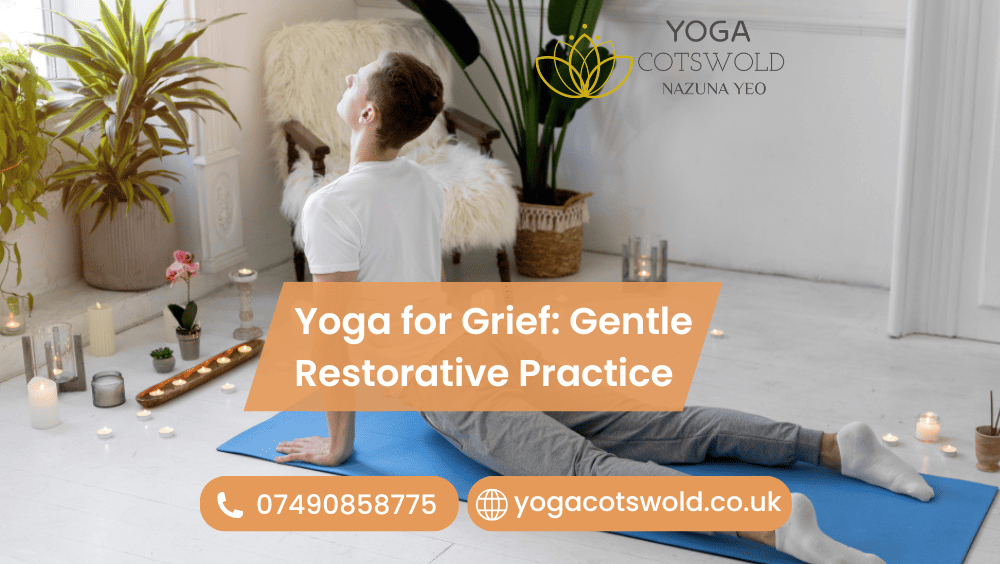
Yoga for Grief: Gentle Restorative Practice
Yoga for grief offers a soft way to heal after loss. A gentle restorative practice uses slow breathing, supported poses & relaxation to calm the mind.
HEALTH TIPS
2/18/20266 min read
Grief has its own weather. Sometimes you wake up in the morning, and the world seems a little bit possible. Then, by lunchtime, some little thing — a ping of a message tone, the sight of a street you’ve known your whole life, someone’s perfume scent in passing — can drag you straight back under. It’s confusing. It’s tiring. And if you have ever had the thought “I should be coping better,” know that you’re not alone.
Here is the truth I would offer you from the outset: You do not need to grieve correctly. There is no reward for being “strong”. There will be days when you may feel weepy, or numb, or pissed off at everything and anyone in the world. All of it belongs.
This is where yoga for grief can be quietly helpful—not as a cure, and not as a way to tidy your feelings into something neat. Instead, it can be a gentle place to pause. A small practice that supports your body while your heart carries what it carries.
I’m NAZUNA YEO, yoga teacher at YOGA COTSWOLD, and this article shares a gentle restorative practice for heavy days—especially the ones where you’re not sure what you need, only that you can’t keep holding everything up by yourself.
Grief doesn’t just live in the mind—it lives in the body
Even when you’re “fine”, your body may tell a different story. Grief can show up as:
a tight chest or shallow breathing
a heavy stomach, poor appetite, or cravings
restless legs and broken sleep
tension in the jaw, shoulders, or hips
fatigue that feels bone-deep
This isn’t weakness; it’s biology. The nervous system can be triggered into survival mode by a loss. So you may feel wired, diffuse or stalled. That means it may feel hard to relax, even if you really want to.
This is why restorative yoga for grief is about being supported rather than making effort. It helps your body to get the message: “You’re safe enough, right now, to soften a bit.” And sometimes that slight shift is the world. Get details on Yoga Teacher in Leckhampton.
What restorative yoga really is (and what it isn’t)
Restorative yoga is slow, intentional and heavily supported. You are using props — pillows, blankets, bolsters — so that you’re not “holding” a posture. Instead, the posture holds you.
But restorative yoga is not about pushing through. It’s not a workout. It’s not about getting flexible. When you’re in grief, that does matter, because your system is already under strain. So instead of asking your body to do more, restorative yoga asks: can you let the floor help?
And, too, emotions can emerge in stillness. If that happens, you’re not doing it wrong. You are just meeting what is already there.
A soft start: setting up your space
Keep this simple. You don’t need a perfect studio corner. However, a little preparation can help you feel held.
You’ll need:
two pillows (or cushions)
one blanket (or two, if you get cold)
a towel (rolled) for extra support
A few gentle touches:
dim the lights, if you can
have tissues and water nearby
put your phone on silent
choose one sentence as an anchor: “Today I’m allowed to go gently.”
If lying down doesn’t feel safe today, do the practice seated or shorten it. Either way, it still counts. Looking for a Yoga Teacher in Pittville?
Yoga for Grief: a gentle restorative sequence (20–30 minutes)
Approach cautiously, as if you are shielding something tender — because you are.
1) Arrive with hand-on-heart breathing (2–3 minutes)
Sit with your back supported on a chair or floor.
Try having one hand on your chest and another on your belly.
Try to inhale and exhale through the nostril that is still unclogged, if you can.
Then exhale through the mouth, slowly and as if you’re sighing.
If your breath feels short, let it be short. If your thoughts are noisy, let them be noisy. But continue to come back and find warmth in your hands. That touch is a constant signal: I’m here.
2) Supported Child’s Pose (3–5 minutes)
Kneel, with knees apart and big toes touching. Put a pillow or bolster between your chest and thighs. Slowly fold forward and rest your head and upper body completely on the support.
If you don’t want to kneel, do the pose in a chair: Sit at a table or desk and fold forward over stacked pillows.
Remain, and observe how it feels to be upheld. And then let your shoulders melt a little with each out breath. Not a full blast — just a little bit.
Why it helps: It offers a sense of privacy and containment—something grief often craves.
3) Side-lying Rest (3–4 minutes each side)
Lay on your side and place a pillow under your head. Hug a pillow to your chest. Place a rolled blanket or towel between your knees.
Relax the top hand on the pillow you’re holding. Feel that soft squeeze, like a subtle “I’ve got you”.
Switch sides when you are ready.
Why it helps: Lying on the side can feel more secure than lying on a flat surface, especially if there is tightness in your chest or feelings that are near the surface. Get details on Yoga Teacher in Prestbury.
4) Supported Heart Opener (optional, 2–5 minutes)
This one is optional. Some people like it as a comfort; others, too open. Trust your body.
Lay a blanket or bolster lengthwise along your spine. Sit at one end, “on your tushie,” and recline back so that you’re supported. Maintain a slight bend in the knees, feet on the floor.
if anything’s wobbly (give one hand to your ribs and one to your belly), then make the exhale just a bit longer.
Why it helps: It can make space for the breath, particularly when grief feels weighty on the chest.
5) Legs Up the Wall (5–10 minutes)
Rest your hips close to a wall and kick your legs upward. If it feels comfortable, place a pillow underneath your hips. Cover yourself with a blanket.
If these don’t work for you, “try legs on a chair”: lie down and place your calves on the seat of a chair.
Soften your jaw, then your tongue, then the area between your eyebrows. Thoughts will come. When they do, take note of them and gently return to the feeling of being supported.
Why it helps: This posture can ease physical heaviness and encourage a calmer nervous system response.
6) Closing: a grief-friendly reflection (2 minutes)
Rest in any position that feels kind—on your side, on your back, or seated.
Silently repeat:
“This is a heavy moment.”
“I don’t have to rush it.”
“May I be gentle with myself.”
Then take one slow inhale… and one longer exhale. Looking for a Yoga Teacher in Stow-on-the-Wold?
When a full practice feels impossible
Some days, 20 minutes is too much. That doesn’t mean you’re failing—it means you’re human.
Try one small thing instead:
feel both feet on the floor for 60 seconds
roll the shoulders slowly five times
hug a pillow and breathe out longer than you breathe in (five rounds)
sit with one hand on the heart and whisper, “I’m here.”
Tiny practices build steadiness. And in grief, steadiness is a form of care.
Related Articles:
» Yoga for Scoliosis: Gentle Poses to Even Out Tension
» Starting Yoga Again After a Break: A Gentle 4-Week Plan
» How Often Should You Do Yoga to See Results?
» Morning Yoga for Beginners: 10-Minute Wake-Up Flow
» Yoga for Glutes and Hips: Build Strength Without Bulking
How often should you practise?
There’s no perfect plan. Still, gentle consistency can help.
On raw days: 5–10 minutes, a few times a week
On restless days: a short daily practice can be more helpful than long sessions
On tender days: stick to supported shapes and calming breath
And, too, if practice brings up emotions that feel unbearable, you might want to reach out to a counsellor or grief specialist. It can hold you up, but it shouldn’t bear the whole weight of your grief.
FAQs on "Yoga for Grief: Gentle Restorative Practice"
1) Can yoga help with grief?
Yes — yoga for grief can help support the nervous system, release tension and offer grounding when feelings seem out of control.
2) Is restorative yoga best when grieving?
Often, yes. Restorative yoga is low-cost and supportive, fitting for heavy days and a lack of energy.
3) When can I start yoga after a loss?
When you’re ready, if ever — even if that’s one minute of breathing with a hand on your heart.
4) What if I cry during practice?
A good cry is a healthy one. If it feels safe, allow it. If not, sit up, have a drink of water and get back to ground.
5) I feel numb. Will yoga still help?
Yes. Numbness is common in grief. Practice with gentle movements can also reintroduce you to your body slowly and subtly, without pressure.
6) Which pose helps most on heavy days?
It can be extra comforting for many people to perform legs-up-the-wall, or side-lying rest.
7) Can yoga reduce grief-related anxiety?
Supported poses and lengthened exhales can support settling the nervous system.
8) Do I need yoga props?
No, pillows and blankets are great. Comfort matters more than equipment.
9) Is breathwork safe during grief?
Something like gentle breath awareness is usually fine. Avoid intense techniques. If breathwork sounds triggering, concentrate on your feet and hands.
10) How long should a restorative session be?
But even 10 minutes can be helpful. If you have 20 to 30 minutes, even better.
11) Do I need to be flexible for restorative yoga?
Not at all. Restorative yoga is as much about support as it is stretch.
12) Should I practise alone or with a teacher?
Both can help. An instructor — like NAZUNA YEO at YOGA COTSWOLD — can provide modifications and a calm, comforting rhythm.
Contact
info@yogacotswold.co.uk
Social Media
Get in Touch
07490858775








Address: GEORGE MOORE COMMUNITY CENTRE- BOURTON ON THE WATER
Moore Road, Bourton on the Water GL54 2AZ