How One-to-One Yoga Can Help You Reach Your Wellness Goals
One-to-one yoga offers personalized guidance, improves flexibility, reduces stress, and supports wellness goals.
HEALTH TIPS
6/2/202615 min read
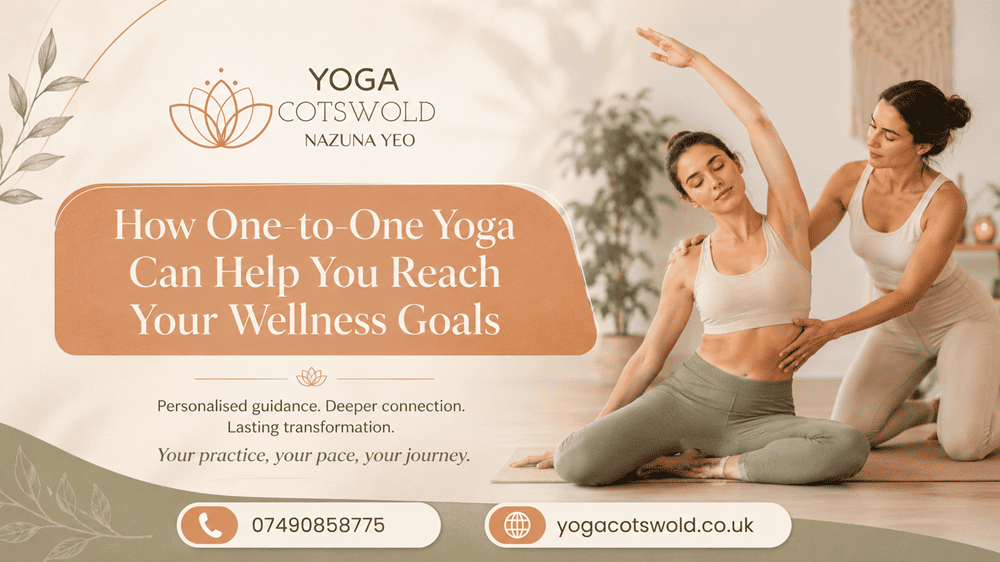
Whenever I hear people asking me about how to grow your yoga practice, I internally smile, because most human beings. But true progress is dogged knee wobblyness, forgetting to breathe and an amused snicker thrown in when left and right appear as if they have just melted away. At Yoga Cotswold, I have seen students arrive nervous, stiff, curious, tired, hopeful, and sometimes all of those at once. As a Nazuna Yeo yoga teacher, I can tell you this: one-to-one yoga gives you space to learn at your pace, with care, honesty, and proper attention.
Where Every Yogi Begins: The Beauty of Being a Complete Beginner
Every student begins somewhere. Even so, dozens of individuals put off that first lesson, since yoga seems like it resides only in the bodies of elastic folks sitting immune to distraction on sweetly cushioned carpets at a calm studio. Honestly, this is the stage which confused me the most when I was learning as well. This idea that I had to know everything to get on the mat is now amusing — yoga is learned by doing!
A yoga practice is not meant to intimidate you, it is crafted to make you feel able! And so even as I started taking classes at Yoga Cotswold, I quietly promised myself to never push a new student. Some come in scared about touching their toes. Some are scared of being monitored, getting the breath wrong – or not knowing the names of poses. But the thing with one-to-one yoga is that you can leave that pressure behind, because your practice starts with just you, as opposed to a room full of people all moving at a well-structured speed.
One on one teaching and personal instruction will help make the initial weeks a lot less overwhelming as a yoga beginner UK. Working one on one also gives me the chance to pay attention to the little things; their stance, their breath patterns, where they are holding tension and how hard they push themselves. These small details matter. They shape confidence.
At Yoga Cotswold, I always say the same thing to each new student: You don't have to arrive prepared – you just have to arrive. Now, bear with me — it actually becomes quite pretty at the beginner layer. You learn to listen. You learn to pause. Most importantly, you realize that your body has been talking to you for years and all the yoga does is make it clearer. Get details on Yoga Studio in Cheltenham.
Yoga Fundamentals: The Building Blocks You Cannot Skip
Yoga fundamentals are a must before anyone goes anywhere near deep backbends or impressive balances. They're not boring basics, but they can seem pretty simple from the outside. They create safety, confidence, and long-term progress. With them, it can turn your yoga practice into a competition of shapes rather than an ongoing exchange with your body.
It all revolves around the breath. In just simple pranayama, you start noticing the depth, texture and rhythm of your breath. Often the nervous system relaxes, the body is less defended and movement becomes more intelligent. Similarly, alignment awareness teaches you to sense when your joints, spine, hips and shoulders are braced.
However, alignment never means forcing your body into a textbook shape. I would rather see a student move with awareness than copy a pose beautifully and feel pain afterwards. At Yoga Cotswold, Nazuna Yeo often reminds students that the body changes day by day, especially with work stress, sleep, weather, age, and mood. Yes, even Cotswolds dampness has a say sometimes.
Mountain Pose (Tadasana)
Duration: Hold for 5–8 breaths
Start standing upright, rooted with your feet on the earth and arms by your side. Breathe in lightly through the nose, spine lengthens; breathe out, shoulders melt away from ears.
Alignment tip: Do not lock your knees; allow the legs to have a softer, living quality.
Nazuna: This is what I call 'the quiet teacher pose' because then i can know everything about how you stand/breathe and act.
Child's Pose (Balasana)
Duration: Rest for 6–10 breaths
Start in kneeling with knees hip distance, toes to heels. Inhale, open your frontal ribs to the sky and on exhalation allow your sternum to drop down into the mat with wider back ribs.
The Misalignment: You shuffle your hips down (if you feel limited in the knees, reach for a cushion under them)
Nazuna: "Sleeping is a skill, not a sign of weakness. I always have to told students about this.
Downward-Facing Dog (Adho Mukha Svanasana)
Duration: Hold for 4–6 breaths
Start on hands and knees, point your toes and lift up and back. On your cusp of inhale, lengthen the spine, on your threshold of exhale hands press gently as the heels melt down.
Aligned: Avoid rolling in the shoulders, spread through fingers and lift from the hips
Nazuna: This means bending your legs first. Straight legs can take a back seat to an elongated spine. Looking for a Private Yoga in Cheltenham?
The Intermediate Stage: Where the Real Growth Happens
The intermediate yoga phase is often one of the most deliciously awkward phases you will ever experience. You know enough to identify what you do not yet know, which can be both invigorating and mildly irritating. One week you feel powerful, and then for no apparent justification, balance vanishes the next. But, oftentimes this “messy middle” yields the truest sense of growth.
By this time, expanding your yoga practice is now more about how you get into and out of shapes than what new ones you learn. Moreover, strength and flexibility must develop simultaneously. Flexibility and mobility without strength can leave joints feeling unstable, while strength and tightness without mobility can create stiffness in the body. Therefore, we work gradually.
When I guide students at Yoga Cotswold, I often structure progression in layers. First, we revisit foundations. Then, we add longer holds, steadier transitions, and breath-led movement. After that, we explore options that suit the student’s body rather than forcing one fixed path. For example, one person may need more hip stability before lunges feel comfortable. Another may need shoulder mobility before weight-bearing poses feel safe.
The yoga stages of learning are rarely straight lines. Instead, they twist, pause, and sometimes loop back. That said, returning to basics does not mean going backwards. It often means your awareness has matured enough to notice more. This is why one-to-one yoga can help so much. A teacher can spot when you need challenge, when you need patience, and when you simply need to stop gripping your jaw. We all do it. Even in the Cotswolds. Get details on 1 to 1 Yoga in Cheltenham.
Yoga Progression Tips: How to Move Forward Without Pushing Too Hard
Good yoga progression tips rarely sound dramatic. Practise regularly. Rest properly. Stay curious. Ask for help. Yet, these simple habits build the strongest foundations for growing your yoga practice over months and years.
First, choose consistency over intensity. Doing a little often beats one epic session and six days of not going near the mat. Equally, rest days matter as your muscles and connective tissues need time to adapt to your nervous system. Yoga is made to leave you feeling more connected, not permanently exhausted.
Journalling can also help. Unless you like the idea of a poetic notebook filled with candlelit musings, you don’t need to. Instead, add two or three lines after practice — what was easy, what felt tight, what surprised you and how did it feel emotionally? Over time, patterns appear.
However, balance teacher guidance with yoga self-practice. A teacher helps you understand alignment, breath, and safe progress, whilst home practice teaches independence. At Yoga Cotswold, Nazuna Yeo encourages both. One-to-one sessions give you clear direction, and your personal practice helps you absorb it.
Plateaus deserve kindness too. Sometimes progress slows because your body integrates what it has learnt. At the same time, plateaus can reveal old habits, fear, or boredom. Therefore, rather than pushing harder, ask better questions. Am I breathing well? Am I rushing? Do I need rest, variety, or guidance? Progress often returns when pressure softens.
Yoga Consistency: Why Showing Up Matters More Than How You Show Up
Yoga consistency does not mean practising perfectly. It means returning. Again and again. Some days, that may mean a full hour of movement, breathwork, and stillness. Other days, it may mean five minutes in Child’s Pose before the kettle boils. Both count.
Practically speaking, the body works repeatedly. When you do movements with conscious intention, your nervous system lays new and safer pathways, your muscles fire better, and you balance is more stable. Correspondingly, access to your breath is a bit easier in times of stress. Thus yoga starts to walk out of the mat with you, into emails, traffic, family life and when the washing machine decides it wants to create drama.
Philosophically, consistency teaches devotion without obsession. It asks you to show up without needing fireworks every time. With this in mind, growing your yoga practice becomes less about achievement and more about relationships.
For home practice, start small. Choose ten minutes. Keep your mat visible if possible. In addition, repeat a simple sequence until it feels familiar: breathing, gentle warm-up, standing pose, forward fold, twist, rest. Short daily sessions often help beginners more than occasional long sessions, because they create rhythm.
As Nazuna Yeo, I often say, “Make it easy enough that you cannot argue with it.” That sounds cheeky, but it works. If your plan feels realistic, you will return. And when you return, your practice quietly changes you. Looking for a Yoga Teacher in Leckhampton?
Advanced Yoga Poses: A Honest Look at What “Advanced” Really Means
Advanced yoga poses attract attention, but advanced yoga does not mean tying yourself into a shape that looks impressive online. In truth, advanced practice often looks calm, steady, and deeply honest. It means you know when to attempt, when to adapt, and when to leave a pose alone for another day.
Advanced body awareness includes breath control, joint sensitivity, emotional steadiness, and patience. Therefore, someone holding a simple lunge with full attention may practise more “advanced” yoga than someone forcing a handstand whilst barely breathing. I know, not as glamorous. Still true.
I introduce challenging poses gently at Yoga Cotswold. First we prepare the wrists, shoulders, spine, hips and core. We also utilize props, walls, and progressions. Yoga poses step by step is where this comes in because the journey into a pose teaches more than an end shape.
Crow Pose (Bakasana)
Duration: 3–5 breaths hold or do short lifts
Starting from a low squat with your hands positioned on the mat shoulder-width apart. So bend your elbows just a little bit, bring those knees high up on your upper arms, inhale to ground yourself and then exhale as you shift weight forward, one foot might lift up.
ALIGNMENT: DO NOT DROP THE HEAD LOOK AT THE GROUND SLIGHTLY AHEAD TO MAINTAIN BALANCE
Nazuna: Crow teaches courage in a humorous way. Part of the lesson is falling.
Wheel Pose (Urdhva Dhanurasana)
Duration: Hold for 3–5 steady breaths
Lie on your back with knees bent and feet hip-width apart, then place your hands beside your ears. Inhale to prepare, then exhale as you press through your feet and hands to lift your chest and hips.
Alignment tip: Avoid letting your knees splay wide; keep them tracking forwards.
Nazuna says: “I never rush backbends. The spine likes invitations, not orders.”
Headstand (Sirsasana)
Duration: Practise preparation or hold for 3–8 breaths with guidance
Begin kneeling, interlace your fingers, and place your forearms firmly on the mat. With a teacher’s support, inhale to lengthen through your spine, then exhale as you slowly walk your feet closer without kicking up.
Alignment tip: Do not dump weight into your head; press strongly through the forearms.
Nazuna says: “Headstand asks for humility. Learn the preparation properly before chasing the full pose.” Get details on Yoga Teacher in Pittville.
Yoga Mindset: The Inner Journey That Runs Alongside the Physical One
You can change everything by a healthy yoga mindset. If you hold the same pose with ambition then it feels different than when you do it from fear, curiosity or kindness. So the inner matters as much as the outer work.
Non-attachment can sound all high and airy but in life it feels very down to earth. Which essentially is to do your best, with non-attachment to the result as such. For instance, you are working to master your Crow Pose, but that pose does not define the worth of your practice. Moreover, patience allows you to honor your body and its own timing instead of demanding immediate shifts.
The ego often sneaks into yoga wearing very tidy clothing. It whispers, “You should be better by now,” or “Look at that person; why can’t you do that?” However, one-to-one yoga gives us room to notice these thoughts without shame. At Yoga Cotswold, Nazuna Yeo guides students back to breath, sensation, and self-compassion.
Mental blocks often hold physical tension. A student may fear falling, avoid rest, or feel frustrated by slow progress. As such, I use gentle questions: What are you trying to prove? Can you soften by ten per cent? What would this pose feel like without judgement? Growing your yoga practice requires honesty, and sometimes that honesty begins with admitting, “I am trying too hard.” That sentence alone can change a practice. Looking for a Yoga Teacher in Prestbury?
Building a Yoga Self-Practice: Making the Mat Your Own
A strong yoga self-practice helps you carry yoga into daily life. However, it does not need to look polished. Your home practice may include pyjama trousers, a dog wandering across the mat, or a doorbell interrupting Savasana. Real life joins in. That is fine.
Begin by choosing a simple structure. First, breathe. Then warm the spine with gentle movement. Next, add two or three standing poses, a seated stretch, a twist, and a few minutes of rest. In addition, choose a clear focus: hips, shoulders, energy, calm, balance, or recovery. This gives your practice direction without making it rigid.
How long should you practise? Ten to twenty minutes can work beautifully. Meanwhile, longer sessions may suit weekends or quieter mornings. Props also help. Blocks, blankets, cushions, and straps make poses more accessible and more intelligent, not less “proper”.
Yoga Cotswolds students often use one-to-one lessons to build home sequences that suit their bodies. For beginners, I may offer a short grounding routine. For intermediate students, I might include strength work, mobility drills, and breath-led flow. For experienced students, we refine subtle details and prepare challenging poses safely.
At Yoga Cotswold, the aim is not dependence on a teacher forever. Instead, good teaching helps you trust yourself. Moving forward, your mat becomes less like a performance space and more like a quiet conversation.
Related Articles:
» Simple Yoga Practices to Reduce Stress and Improve Daily Energy
» Why Practising Yoga Daily Can Transform Your Life?
» Yoga for Flexibility: 7 Essential Poses You Should Practice Daily
» Yoga for Flexibility: Split Training Without Overstretching
» Evening Yoga to Unwind: A Gentle Routine for Better Sleep
A Final Word from Nazuna Yeo
When I think about one-to-one yoga, I think about the small moments: a student breathing more freely, standing taller, laughing after losing balance, or realising they do not need to fight their body anymore. Those moments matter to me.
At Yoga Cotswold, my aim is never to make everyone practise the same way. Instead, I want to help you understand your own body with warmth, patience, and a little courage. Whether you are brand new, returning after years away, or ready to explore deeper work, there is a thoughtful way forward.
So, start where you are. Not where you think you should be. Bring your stiff hamstrings, busy mind, tired shoulders, and curious heart. I will meet you there. And together, gently and honestly, we can begin growing your yoga practice in a way that feels like yours.
FAQs: How One-to-One Yoga Can Help You Reach Your Wellness Goals
1) I've never done yoga before — where should I honestly start?
Start with a gentle class or one-to-one session where the teacher can see how your body moves. In addition, tell the teacher about injuries, energy levels, stress, and any worries you have. A complete beginner does not need strength, flexibility, or special knowledge before starting. You need clear guidance and a kind pace. At Yoga Cotswold, Nazuna Yeo usually begins with breathing, simple standing posture, basic mobility, and rest. This helps you feel safe before adding more movement. Above all, begin smaller than you think you need to. Confidence grows quickly when the first step feels manageable.
2) How long does it take to progress from beginner to intermediate yoga?
Most students notice progress within a few weeks, especially when they practise regularly. However, moving from beginner to intermediate yoga often takes several months rather than a fixed number of classes. It depends on your body, consistency, confidence, and previous movement experience. For example, someone with a dance or sport background may understand body awareness quickly, whilst another person may need more time with balance or breath. That said, time matters less than quality. If you learn the basics well, your progress feels safer and more lasting. Growing your yoga practice works best when you respect your own rhythm.
3) Can I practise yoga at home without attending classes first?
You can practise simple yoga at home, but I recommend at least a few guided sessions first if possible. A teacher can help you understand safe alignment, breathing, and suitable options for your body. In addition, beginners often copy shapes without noticing strain in the wrists, knees, lower back, or neck. Home practice works beautifully once you know what to look for. Start with short, simple movements and avoid advanced poses until you receive guidance. At Yoga Cotswold, one-to-one sessions often include a personalised home sequence, so students can practise independently with confidence rather than guesswork.
4) What are the most important yoga poses for a complete beginner to learn?
A complete beginner benefits from learning Mountain Pose, Child’s Pose, Cat-Cow, Downward-Facing Dog, Low Lunge, Warrior II, Seated Forward Fold, a gentle twist, and Savasana. However, the names matter less than the principles behind them. You want to learn grounding, spinal movement, breath awareness, gentle strength, and relaxation. In addition, beginners should understand how to modify poses using props. Nazuna Yeo often teaches poses slowly, with simple cues and time to ask questions. This approach builds confidence. Once the foundations feel familiar, more variety can enter the practice without creating confusion.
5) How do I know when I'm ready to move to an intermediate level?
You may feel ready for intermediate yoga when you understand basic poses, breathe steadily during movement, and know how to adjust when something feels wrong. In addition, you should feel curious rather than pressured. Intermediate practice often includes stronger transitions, longer holds, balance work, and more detailed alignment. However, readiness does not mean every beginner pose feels perfect. It means you can practise with awareness. If you feel unsure, ask a teacher to assess your movement. At Yoga Cotswold, Nazuna Yeo often blends beginner and intermediate options, so students progress without feeling pushed into a level that does not suit them.
6) Is there an age limit for progressing to more advanced yoga poses?
No fixed age limit exists, although age, health history, injuries, strength, and confidence all matter. Many people progress beautifully later in life because they bring patience and body awareness to the mat. However, not every advanced pose suits every body, and that is not failure. For example, wrist issues may affect arm balances, whilst neck concerns may make headstand inappropriate. Therefore, a wise teacher offers alternatives. Advanced yoga can mean refined breath, steadier focus, and deeper self-knowledge, not only dramatic shapes. With careful guidance, students of many ages can safely deepen their practice.
7) How many times a week should I practise yoga to see real progress?
For most people, three to four sessions a week creates steady progress. However, those sessions do not all need to last an hour. In fact, ten to twenty minutes of focused practice can help more than one long weekly class. Consistency trains the body and mind through repetition. In addition, shorter sessions feel easier to maintain during busy weeks. Rest also matters, especially if your practice includes strength work or deep stretching. A useful pattern might include one guided class, one one-to-one session when needed, and two short home practices. This balance supports growth without pressure.
8) What should I do when I hit a plateau in my yoga practice?
First, do not panic. Plateaus happen to everyone, and they often mean your body is integrating previous learning. However, you can respond wisely. Change the pace, revisit basics, ask a teacher to check your alignment, or add strength work if flexibility has become your main focus. In addition, keep a short practice journal to spot patterns. Are you tired? Rushing? Avoiding rest? Repeating the same sequence without attention? At Yoga Cotswold, Nazuna Yeo helps students see plateaus as useful information rather than failure. Sometimes the answer is challenge. Sometimes it is rest.
9) Do I need to be flexible to start yoga — or does yoga make you flexible?
You do not need to be flexible to start yoga. That is rather like saying you need to be clean before having a bath. Yoga can improve flexibility over time, but it also builds strength, balance, coordination, breath awareness, and calm. In addition, flexibility should develop gradually, with support from active strength. Forcing stretches can irritate joints and tissues, especially if the body feels cold or tense. A beginner should focus on sensation rather than depth. If you practise regularly and listen well, mobility usually improves. More importantly, you learn how to move with greater ease.
10) How does Nazuna Yeo's teaching approach differ from a standard yoga class?
Nazuna Yeo’s teaching style places personal attention at the centre. Rather than asking every student to fit the same sequence, she watches how each person moves and adapts the practice accordingly. In addition, she blends clear alignment cues with warmth, patience, and gentle humour. A standard group class can be valuable, but one-to-one yoga offers more detail. You can ask questions, work around injuries, build confidence, and progress at your own pace. At Yoga Cotswold, Nazuna Yeo focuses on helping students understand their bodies, not just copy poses. That difference can transform the whole experience.
11) What classes does Yoga Cotswold offer for different levels of experience?
Yoga Cotswold supports students at different stages, from complete beginners to those exploring stronger or more refined practice. Depending on the timetable, students may find gentle yoga, Hatha-based classes, one-to-one sessions, and personalised support for developing home practice. In addition, private lessons can help people with specific goals, such as improving mobility, reducing tension, building confidence, or preparing for intermediate work. If you feel unsure about the best starting point, contact Yoga Cotswold and explain your experience level. A good class should meet you where you are, not make you feel behind before you begin.
12) How do I stay motivated when my yoga progress feels slow?
Slow progress can feel frustrating, especially if you compare yourself with others. However, motivation becomes easier when you measure more than poses. Notice your breathing, sleep, posture, patience, mood, and energy. In addition, set small goals, such as practising twice this week or holding a pose for one extra breath. Celebrate quiet wins. They count. It also helps to work with a teacher who can show you progress you may not notice yourself. Nazuna Yeo often reminds students that yoga changes us in layers. Some layers move slowly, but they often last the longest.
Contact
info@yogacotswold.co.uk
Social Media
Get in Touch
07490858775



Address: GEORGE MOORE COMMUNITY CENTRE- BOURTON ON THE WATER
Moore Road, Bourton on the Water GL54 2AZ