Finding Balance: How Yoga Transforms Mind, Body and Breath
Yoga creates balance by connecting movement, breathing, and mindfulness. Regular yoga improves strength and supports flexibility.
HEALTH TIPS
5/26/202612 min read
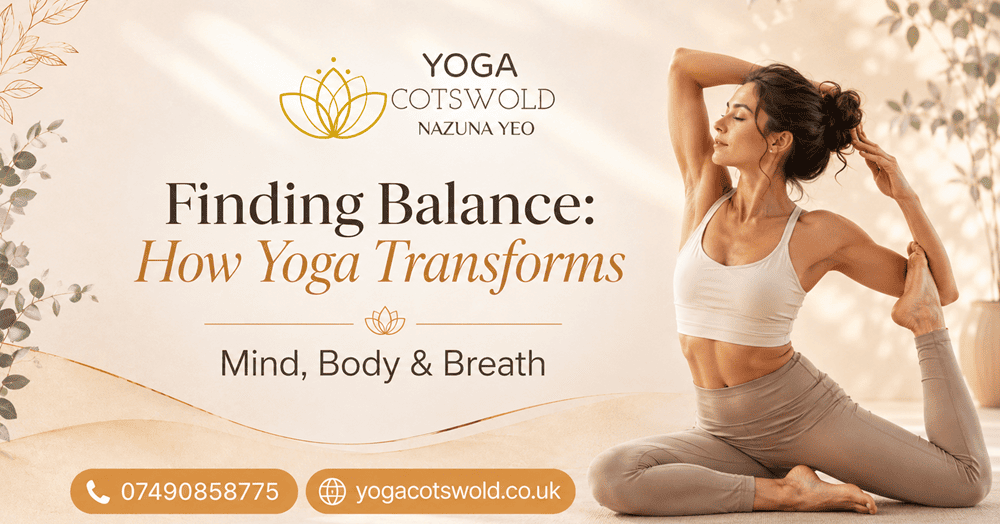
When someone asks me how they should grow their yoga practice I always smile a little because most of us think of progress as something big: a little deeper stretches, a little stronger arms, maybe a brave attempt at upside down balancing. But at Yoga Cotswold I have learned that real growth in yoga is a little quieter. It starts with a breath, a listening, a softening, and turning up again.
Where Every Yogi Begins: The Beauty of Being a Complete Beginner
Every confident yogi rolled out a mat at one time and thought, “Am I doing this right?” I remember that feeling, honestly. When I first started teaching at Yoga Cotswold I found that new students often came with the same fears; not being flexible enough, not knowing the names of poses or that everyone else would look graceful and they’d look like a folded deckchair.
That said, a beginner yoga practice isn’t a weakness. It’s a clean, honest place to begin. In fact, beginners are often better listeners than experienced students who have not yet formed habits they need to unlearn.
As a Nazuna Yeo yoga teacher, my first advice to every new student is the same: your first job is not to impress anyone. First of all, you watch. Notice your breathing. Observe your feet . Notice when your shoulders inch up toward your ears as if trying to escape the room.
So if you’re looking for yoga for beginners in the UK, I would say this. Find a class where you feel safe to ask the simple questions. Also, don’t compare your first chapter to someone else’s 10th chapter. Patience, curiosity and a gentle willingness to laugh at yourself are the first steps in developing your yoga practice. Get details on Yoga Studio in Cheltenham.
Yoga Fundamentals: The Building Blocks You Cannot Skip
And before anyone goes off to do advanced yoga poses we get back to the basics of yoga. Breath, alignment, body awareness and steadiness are the cornerstones of a long term practice . Without them, yoga’s just a bunch of shapes, not a way to feel more present in your own skin.
At Yoga Cotswold, Nazuna Yeo often tells students to breathe before they move. And so the body stops guessing and starts responding. Breath practice, or pranayama, doesn’t need to be a mystery. Begin with a nasal breath in, feel the ribs expand, breathe out slowly enough to soften the jaw.
Mountain Pose (Tadasana)
Stand up straight, feet on the ground, arms down at your sides. Breath in, lengthening through the crown of your head. Breath out, letting your shoulders soften, feeling your weight settle evenly.
Alignment tip: Keep knees softly alert, don’t lock them.
“I like Mountain Pose, because it looks simple but it says a lot about a person standing in life,” says Nazuna.
Child's Pose (Balasana)
Inhale and hold for 6-10 breaths Size:
As you kneel, fold your torso to the floor and bring your Big Toes together Breathe into your back ribs and on the exhale draw your hips slightly closer to your heels.
Alignment cue: If you have tight hips, put a cushion or blanket between your thighs and calves.
“Don’t think of Child’s Pose as a loss,” Nazuna says. ‘Listening to me, wisely.
Downward-Facing Dog (Adho Mukha Svanasana)
Duration: Hold for 5-8 breaths
Begin on all fours, tuck your toes, raise your hips, and stretch your spine creating an upside down V. Inhale, press into your palms. Exhale, bend your knees slightly and lift your sitting bones high.
Alignment tip: Don’t force your heels down if it rounds your back.
Nazuna says: “Honestly, this pose tripped me up too when I was learning, so just give it time.” Looking for a Private yoga in Cheltenham?
The Intermediate Stage: Where the Real Growth Happens
The middle stage can feel untidy. You know enough to realise how much you still do not know. However, this is where intermediate yoga becomes wonderfully rich.
Students at this stage begin to build your yoga practice by developing strength and flexibility at the same time. A lunge is no longer just a stretch, for example, it is a study in balance, breath, hip stability and focus. Likewise, a forward fold is less about getting your forehead to the floor and more about meeting your hamstrings with respect.
Progression is slow and layered at Yoga Cotswold, where Nazuna Yeo takes small steps. First we review the known motions. We then add a gentle challenge. Then we say, "Can I remain calm here? This is important, because the body learns by repetition, not panic.
The stages of learning yoga are rarely tidy. One week you are light and open, the next your hips are like old garden gates in February. This is normal. Thus, the intermediate stage requires as much humour as effort.
Yoga Progression Tips: How to Move Forward Without Pushing Too Hard
Good yoga progression tips keep you from making yoga just another task to do. Always favor consistency over intensity. Twenty minutes of hard work can teach you more than one drama class and six days of avoidance.
Rest days allow your body to absorb the work too. Muscles, joints and nervous systems need rest. So progress doesn’t always look like doing more. Sometimes it means doing less more consciously.
Journalling is also helpful. After practice write one line: “Today my breath felt…” or “My balance shifted when…” So you start to see patterns instead of judging individual sessions.
When practising with a teacher, you receive feedback that your own eyes may miss. Meanwhile, yoga self-practice teaches independence. Both matter. At Yoga Cotswold, Nazuna Yeo encourages students to use classes as guidance, then build confidence at home.
Plateaus happen too. In other words, they do not mean failure. They often mean your body is quietly organising new strength, mobility, and awareness beneath the surface. Get details on 1 to 1 yoga in Cheltenham.
Yoga Consistency: Why Showing Up Matters More Than How You Show Up
Consistency in yoga sounds boring, simple even. But that changes everything. The nervous system is nuts for rhythm. Regular practice helps your body recognise safety, settle quicker and move with less resistance as such.
Short daily sessions can often work better than occasional long sessions for developing your yoga practice. Ten minutes of mindfulness can keep the thread. But a single, longer weekly class can work beautifully when life gets full too, as Cotswold's life often does between work, family, school runs, muddy boots and the occasional sheep-related traffic delay.
To build a home rhythm, keep your mat visible. In addition, choose a realistic time. If you are not a morning person, please do not design a heroic 5.30 am programme. That is not discipline; that is comedy waiting to happen.
Nazuna Yeo often says that motivation follows movement. Therefore, begin small. One breath. One stretch. One sun salutation. Consequently, the mind stops arguing and the body begins remembering. Looking for a Yoga Teacher in Leckhampton?
Advanced Yoga Poses: An Honest Look at What “Advanced” Really Means
The word advanced can mislead people. In contrast, true advancement does not mean twisting yourself into a shape that frightens your neighbour. It means deeper body awareness, steadier breath, emotional maturity, and a calmer relationship with effort.
Yes, advanced yoga poses can be exciting. However, they should grow from patience, not performance. At Yoga Cotswold, Nazuna Yeo teaches challenge with care, because courage and caution belong together.
Crow Pose (Bakasana)
Duration: Hold for 3 to 5 breaths.
Start in a squat position, hands shoulder width apart, knees high on arms. Breathe in to fill your chest. Breathe out and step forward. Maybe one foot, then the other.
Alignment tip: Look slightly ahead instead of letting your head drop.
"Crow teaches trust, but also great facial expressions when things wobble," says Nazuna.
Wheel Pose (Urdhva Dhanurasana)
Hold for 3 to 5 breaths Duration:
Lie on your back with knees bent, feet about hip width apart, hands by your ears. Inhale and get ready to exhale, pressing into your hands and feet and lifting your chest into a strong backbend.
Alignment tip: Keep your knees aligned forward, don’t let them go out wide.
Nazuna: “Wheel Pose should never be rushed, the spine deserves manners.”
Headstand (Sirsasana)
Duration: Hold only under teacher supervision
Start with forearms on the floor and fingers interlaced. Lightly place the crown of your head between your hands. Breathe steadily. Walk your feet closer as you lift your hips and only rise when your shoulders support you well.
Alignment tip: Don’t throw your weight into your neck, press firmly through your forearms.
Nazuna says, “Headstand is not a party trick. It demands humility about height. Get details on Private Yoga Teacher in Pittville.
Yoga Mindset: The Inner Journey That Runs Alongside the Physical One
Yoga is honest when there is a strong yoga mindset. Non-attachment does not mean not caring. It means you practice. Not so much clinging to the result that joy disappears.
Patience is the key here. And so does self-compassion. When students struggle, Nazuna Yeo often asks, "Can you be firm but not be hard?" That question shifts the room.
The ego loves to compare. Yoga, on the other hand, asks you to focus on your own breath, your own body, your own day. So if you want to grow your yoga practice, inner honesty is as important as outer discipline.
At Yoga Cotswold it is not unusual to experience mental blocks appearing around balance poses, backbends or stillness. But those moments become fertile ground for learning. We learn to stop, breathe, try again without turning the mat into a courtroom.
Building a Yoga Self-Practice: Making the Mat Your Own
Personal practice doesn’t have to be slick. The fact is that yoga self-practice works best when it fits into your real life. Start with five minutes of breathing; add two or three poses; finish with rest.
If you’re sequencing, just think of it this way: get there, get warm, get moving, cool down, rest. Also, don't be shy with props. Blocks, blankets, straps, cushions, chairs don’t make practice easier in a lesser sense, they make practice smarter.
Beginners may practise for 10–15 minutes. Meanwhile, intermediate students may enjoy 25–40 minutes. However, the real question is not “How long?” but “Did I listen?”
Yoga Cotswold classes support independence by teaching yoga poses step by step, rather than asking students to copy shapes blindly. As a result, students learn how to adapt safely when practising at home. That is a beautiful part of growing your yoga practice.
Related Articles:
» Why Practising Yoga Daily Can Transform Your Life?
» Simple Yoga Practices to Reduce Stress and Improve Daily Energy
» Yoga for Flexibility: 7 Essential Poses You Should Practice Daily
» Yoga for Stress Relief: Simple Routines
» Daily Yoga Routine for Stress Relief and Inner Peace
A Final Word from Nazuna Yeo
When I think about growing your yoga practice, I do not picture a straight road. I picture a Cotswolds footpath after rain: a little uneven, sometimes muddy, often beautiful, and much easier when you stop pretending you must know every step in advance.
At Yoga Cotswold, I have seen people arrive nervous, stiff, tired, curious, grieving, hopeful, or simply unsure what to do with their hands. Then, slowly, they begin to breathe differently. They stand differently. They speak to themselves with a little more kindness. That is yoga doing its quiet work.
So, if you are beginning, begin gently. If you are returning, return without apology. If you are ready for a challenge, let it come with patience. And, if you would like guidance, I would be glad to welcome you to Yoga Cotswold. Bring your body as it is. We can start there.
FAQs: Finding Balance: How Yoga Transforms Mind, Body and Breath
1) I've never done yoga before — where should I honestly start?
Start with a simple beginner class, a little bit of breathing practice and realistic expectations. You don’t need to be super flexible, wear special clothes or have perfect balance. But you must be patient. Nazuna Yeo at Yoga Cotswold says: “For beginners it’s important to learn the basics slowly to stand well, breathe steadily and move without strain. Choose a teacher who explains things clearly and encourages questions. If you are a brand new beginner, focus first on comfort, safety and curiosity. Keep the impressive looking poses. “Your first win is just stepping on the mat.
2) How long does it take to progress from beginner to intermediate yoga?
It depends, but generally, after a few months of consistent practice, most students start to feel more confident. If you practice two or three times a week, you might see improvements in your balance, strength and breath awareness in 8-12 weeks. But stepping into intermediate yoga is more than just holding tougher poses. It also means learning to be in alignment, breath well and know when to take rest. So don’t rush to label. “Quiet progress is important,” Nazuna Yeo often reminds students. Your body may change before your mind is aware of it.
3) Can I practise yoga at home without attending classes first?
You can do some simple yoga at home including breathing, gentle stretches and basic resting poses. But taking at least a couple of classes can help you avoid common mistakes in alignment. A teacher can spot habits that you might not notice, such as rounded shoulders, locked knees, or tense breathing. Classes also help build confidence before home practice gets more independent. If you are starting from home, keep it simple, don't try advanced shapes. Move slowly, use lots of props, and stop if you feel any pain. Let comfort lead you, not ambition.
4) What are the most important yoga poses for a complete beginner to learn?
Mountain Pose, Child’s Pose, Cat-Cow, Downward-Facing Dog, Low Lunge, gentle seated twists will do for complete beginners. These poses teach grounding, spine movement, breath awareness and gentle strength. Plus they’re in a lot of class styles, so knowing them makes you feel less lost. Nazuna Yeo often teaches beginners to focus on how each pose feels, rather than chasing an ideal shape. For instance, Child’s Pose can be done with cushions, and Downward-Facing Dog can be done with bent knees. Good yoga is responsive to the body in front of it.
5) How do I know when I'm ready to move to an intermediate level?
Once you've got basic alignment down, can breathe steady through effort and recover nicely from mistakes, you might be ready for intermediate yoga. You should also be able to change poses without feeling shy about it. Being prepared doesn't mean you can do anything. Instead, it means you are a good listener and remain curious through challenges. If you feel beginner classes are helpful but no longer 100% engaging, talk to your teacher. “Try one slightly stronger class and see how your body feels the next day,” suggests Nazuna Yeo.
6) Is there an age limit for progressing to more advanced yoga poses?
Always listen to your body, history and current health there is no hard age limit. Many people do beautifully later in life, especially as strength, mobility and balance improve steadily. Some of the more advanced poses may not be appropriate for some people with certain neck, wrist, shoulder, blood pressure, or spinal conditions. So guidance is important. At Yoga Cotswold progression is about smart adaptation, not everyone being pushed to the same goal. Advanced practice means breathing more evenly, focusing better, or moving without pain — not being able to stand on your head.
7) How many times a week should I practise yoga to see real progress?
Most people notice progress after two to four sessions a week. However, the sessions do not have to be long. The mix works well. Maybe a class, a home practice and a few short breath-led sessions. An added benefit is that five minutes a day of practice can support mobility and calm better than sporadic intense efforts. Consistency counts, as repetition is how the body learns. That said, rest is important too. If you’re always tired or sore from your practice, ease up on the intensity and build back up gently.
8) What should I do when I hit a plateau in my yoga practice?
First, don’t panic. Plateaus are often signs that your body is assimilating new skills. Stop pushing harder. Change your focus. For example, slow down familiar poses, observe your breath, use props, or have a teacher check your alignment. Keeping a journal can also help you spot progress you may not have noticed. Your balance may not be there yet, but your recovery is more peaceful. That’s important. Nazuna Yeo often says, “Don’t quit during plateaus. Use them as a chance to refine. Sometimes the quiet stages are the most educational.
9) Do I need to be flexible to start yoga — or does yoga make you flexible?
You do not need to be flexible to start yoga. Yoga helps you develop flexibility gradually, although it also builds strength, balance, coordination, and body awareness. In fact, very flexible people often need to learn stability, whilst tighter bodies may need patience and support. Therefore, flexibility is not the entry ticket. It is one possible result of steady practice. Use props, bend your knees, and respect your range. A good teacher will never treat stiffness as failure. It simply shows where your practice can begin.
10) How does Nazuna Yeo's teaching approach differ from a standard yoga class?
Nazuna Yeo teaches with warmth, detail, and a strong respect for individual bodies. Rather than rushing students through shapes, she explains how each movement connects with breath, balance, and daily life. In addition, she encourages questions and offers variations, so students do not feel they must copy one perfect version of a pose. Her approach at Yoga Cotswold blends practical alignment with calm encouragement. Students often appreciate that the classes feel personal without becoming intense or intimidating. There is room for effort, rest, humour, and real learning.
11) What classes does Yoga Cotswold offer for different levels of experience?
Yoga Cotswold supports students at several stages, from complete beginners to those exploring stronger and more refined practice. Beginner-friendly sessions focus on breath, alignment, confidence, and safe movement. Meanwhile, mixed-level classes allow students to choose variations depending on energy and experience. More experienced students can work on strength, mobility, balance, and deeper concentration. In addition, Nazuna Yeo encourages students to ask which class suits them best before joining. The aim is not to place people in boxes, but to help each person practise at a level that feels supportive and worthwhile.
12) How do I stay motivated when my yoga progress feels slow?
Slow progress can feel frustrating, especially when you are putting in effort. However, motivation grows when you broaden what you measure. Instead of only asking whether you can do a harder pose, ask whether you breathe better, sleep more calmly, stand taller, or recover from stress sooner. In addition, keep your practice small enough to repeat. Five steady minutes often beats one ambitious plan that never happens. Nazuna Yeo encourages students to celebrate consistency, not drama. Little by little, the mat becomes a place you return to, not a test you must pass.
Contact
info@yogacotswold.co.uk
Social Media
Get in Touch
07490858775




Address: GEORGE MOORE COMMUNITY CENTRE- BOURTON ON THE WATER
Moore Road, Bourton on the Water GL54 2AZ