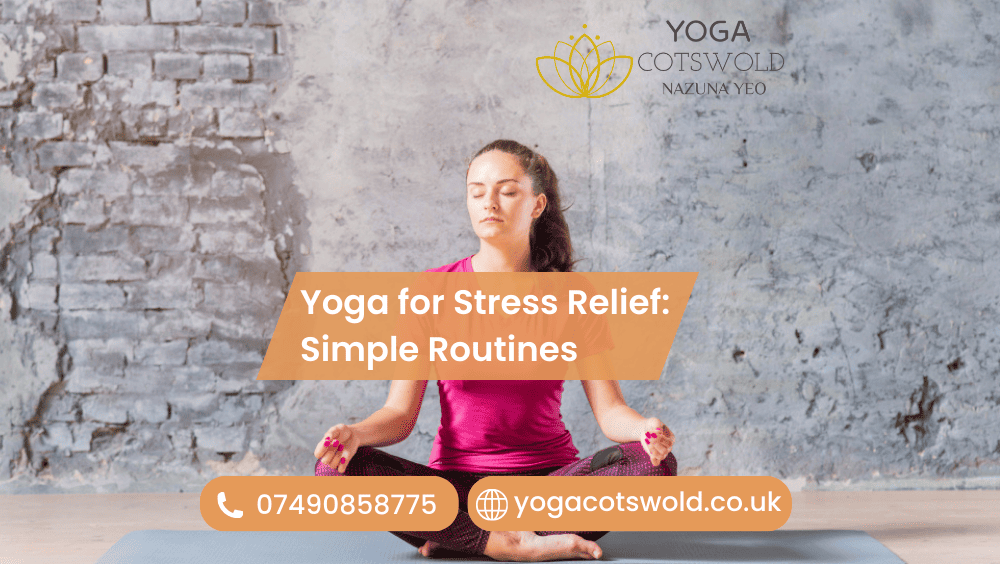
Yoga for Stress Relief: Simple Routines
Yoga helps reduce stress and calm the mind. Simple routines like gentle stretching, deep breathing, and short meditation can fit into busy days.
HEALTH TIPS
3/13/20266 min read
Some days are full before they start. You get up, look at the phone, think of work, family life, errands and messages and that head list is on the move in an instant. By late morning your shoulders are stiff. By evening, your brain still will not turn itself off. It’s something that many people are experiencing now. Life feels busy all the time.
That is precisely why yoga for stress relief is important. It offers you a small amount of space to breathe, slow down and return to yourself. It does not require flawless flexibility, fancy clothing or a whole hour of free time. As a matter of fact, several gentle movements done mindfully will assist more than it is widely believed.
At YOGA COTSWOLD, Nazuna Yeo frequently teaches that yoga doesn’t need to be fancy in order to help. So when life feels chaotic, the body generally longs for softness, breath and clear mechanics that can be turned to time again.
Why yoga helps when life feels overwhelming
Stress doesn’t only live in the brain. It settles into the body too. You may also observe the signs of a clenched jaw, shallow breathing and poor sleep, or headaches and that heavy feeling in the neck and shoulders. Sometimes humans are not even aware the body is tense until they just stop for a moment.
This is where yoga for stress instantly fills the role, in a very normal way. Deep breathing helps relax the nervous system. Gentle stretching also releases the physical muscle tension that we can build up without awareness. Moving quietly also gives the mind one thing to focus on, and that alone can help induce relief.
Yoga is not an escape from your life. It’s more about finding a steadier way to navigate it. That change is subtle, but it counts. Get details on Yoga Teacher in Swindon Village.
What kind of yoga is best for stress relief?
When people feel stressed, they typically believe they need to “do more” in order to remedy it. But stress typically responds to less force, not more. That’s why the most effective stress relief yoga practices tend to be slow, simple and grounding.
Helpful practices usually include:
gentle stretches
slower breathing
seated or lying postures
easy spinal movement
short moments of stillness
After a draining day, you don’t need a hard power flow. A few minutes in a quiet forward fold, even a twist on the floor or five steady breaths at work can do more good.
A simple morning routine for busy people
Morning sets the tone. If the day begins rushed, the body tends to remain in that state of rush. Your first thing in the morning tone, such as a quick stress relief morning yoga routine, can keep you feeling able to tackle the entire day ahead.
1. Easy seated breathing
Find a floor, cushion or sit on the edge of your bed. Let your spine rise naturally. Inhale through the nose and exhale slowly. Do not force anything. Just allow the breath to lengthen increasingly.
Wait here for a minute or two. It aids in quieting the mental chatter before the day becomes noisier.
2. Cat-Cow
Come onto hands and knees. Inhale, your chest gently lifting as the front of your body opens. Inhale as you curve the spine and let the head hang, exhale.
If this move is done first thing in the morning, it feels especially decadent because there’s no extreme tension on the back but it still wakes the body up.
3. Child’s Pose
To come back into Child’s Pose, draw the hips back toward the heels and lower the torso. Your knees will also be either wide or closer together. Rest the forehead on the mat or on folded hands.
Asanas such as Child’s Pose are very beneficial for stress relief. It is safe, grounded and quiet.
4. Standing Forward Fold
Stand hip-width apart with knees bent slightly. Lean forward, and allow the head to hang. The legs need not be perfectly straight.
It facilitates the letting go of tension in the back body and often calms a busy mind too.
5. Mountain Pose
Ground both feet into the floor and stand tall. Relax the jaw. Soften the shoulders. Take a deep breath and pick a word for the day: calm, steady, ease or patience.
It is simple, yes. Still, it works. Looking for a Yoga Studio in Cheltenham?
A quick midday reset when stress builds up
Many people feel most tense during the middle of the day. Work piles up. Emails keep coming. You have been sitting too long. Your neck starts complaining. At that point, a short break can change everything.
This quick yoga routine for busy lives can be done at home or even at work.
Neck stretch
Drop one ear towards one shoulder, then slowly change sides. Keep it gentle.
Shoulder rolls
Lift the shoulders up, roll them back, and let them drop. Repeat several times.
Seated twist
Sit upright in a chair and turn softly to one side, then the other. Keep the breath smooth. Get details on 1 to 1 yoga in Cheltenham.
Wrist stretch
Stretch one arm forward and lightly draw the fingers back. Repeat on the other side.
Three deeper breaths
Close your eyes if you can. Breathe in slowly. Breathe out even slower.
This kind of practice may take only a few minutes, but it interrupts the stress cycle before it gets bigger.
An evening yoga routine to unwind properly
Evening is often when tiredness and stress show up together. Your body is worn out, but your mind still keeps going. This is why a calm evening yoga for stress relief practice can feel so comforting.
1. Legs Up the Wall
Sit next to a wall, recline and lift your legs. If that feels too awkward, then instead prop the lower legs up on a chair or sofa.
This is very restorative after a long day. That simplicity is also why so many people adore them.
2. Supine Twist
Lie on your back, hug in one knee and then let it cross the body. Stretch the opposite arm, if it feels nice. Repeat on the other side.
Twists can liberate the back and waist after long periods of sitting.
3. Happy Baby
With the back on the floor, holding the backs of thighs, shins or feet. Keep it easy. Yank – You don’t need to pull hard
This posture can help free the hips and low back, where tension often settles in.
4. Savasana
Lie flat on your back, arms relaxed, feet open. Let the body become heavy. Let the face soften.
Three to five minutes here can even be a reset button. Looking for a Yoga Teacher in Leckhampton?
How often should you do yoga for stress?
You do not need to practise for a long time every day. What helps most is regularity. A little bit, done often, tends to support the body better than a long class once every few weeks.
For example:
5 minutes in the morning
3 minutes during the afternoon
10 minutes before bed
A few gentle reminders
Also, yoga doesn’t have to look pretty. Some days will be distracting, your mind is not all there. You might feel stiff, distracted or a little grumpy some days. That is alright. You are still practising.
At YOGA COTSWOLD, Nazuna Yeo welcomes people to meet yoga in a gentle, human manner. Not as a thing to accomplish but as a space to soften and return to oneself.
Related Articles:
» Yoga for Carpal Tunnel & Tight Forearms
» Morning Yoga for Beginners: 10-Minute Wake-Up Flow
» Yoga in Managing PCOS and Hormonal Imbalance
» Can Yoga Help Manage Chronic Pain?
» Yoga for Mental Health & Stress Relief: Reclaim Your Calm with Every Breath
Start Your Stress-Relief Routine Today
Yoga for stress relief in releasing tension doesn't have to be dramatic, though, to work. A few minutes spent moving and breathing quietly, slowly contorting our bodies into postures that feel good get to add up to something big — especially when life seems infinite. And ultimately these little routines have a way of making you feel at least a little calmer, a little more solid and able to inhabit your own body.
So if your days feel too frantic and your brain feels too blocked, begin taking small step.Roll out the mat. Sit down. Take one breath. Then another. That is enough for today. Tomorrow, you begin again.
FAQs – Yoga for Stress Relief
1. Is yoga good for stress relief?
Yoga is good for reducing stress, and it slows your breath, it release physical tension but it may not calm the mind.
2. How many minutes of yoga should I do for stress?
Even if it’s just five to ten minutes a day, that helps — particularly if it becomes a habit.
3. What is the best type of yoga for stress?
Even if it’s just five to ten minutes a day, that helps — particularly if it becomes a habit.
4. Can beginners do stress relief yoga?
Yes, beginners can do basic poses like Child’s Pose, Cat-Cow and Forward Fold and Savasana [lying flat].
5. Does yoga help with anxiety and stress?
Yoga helps to reduce stress and anxiety by slow breathing, and bringing you back to the moment.
6. What are the best yoga poses for stress relief?
Among the most restorative poses are Child’s Pose, Legs Up the Wall, Supine Twist, Forward Fold and Savasana
7. Is morning yoga or evening yoga better for stress?
Both are helpful. Yoga in the morning can energize you for the day ahead (morning is when we are typically our most limber), and yoga in the evening can relax you into slumber.
8. Can I do yoga for stress at home?
Now, stress-relieving at-home yoga classes don’t even require much space or equipment.
9. Do I need to be flexible to do yoga?
No, flexibility is not required. You don’t have to be flexible, or of a specific age or size in order to do yoga — it is for everybody and everybody.
10. Can yoga help me sleep better when I am stressed?
Yes, a gentle and calming evening practice is indeed good for the body and can prepare you to sleep.
Contact
info@yogacotswold.co.uk
Social Media
Get in Touch
07490858775




Address: GEORGE MOORE COMMUNITY CENTRE- BOURTON ON THE WATER
Moore Road, Bourton on the Water GL54 2AZ