Hatha vs Vinyasa vs Yin: Which Yoga Style Is Best for You?
Hatha yoga builds strength and balance, Vinyasa boosts energy and fitness, while Yin improves flexibility and relaxation. Choose based on goals.
HEALTH TIPS
2/6/20266 min read
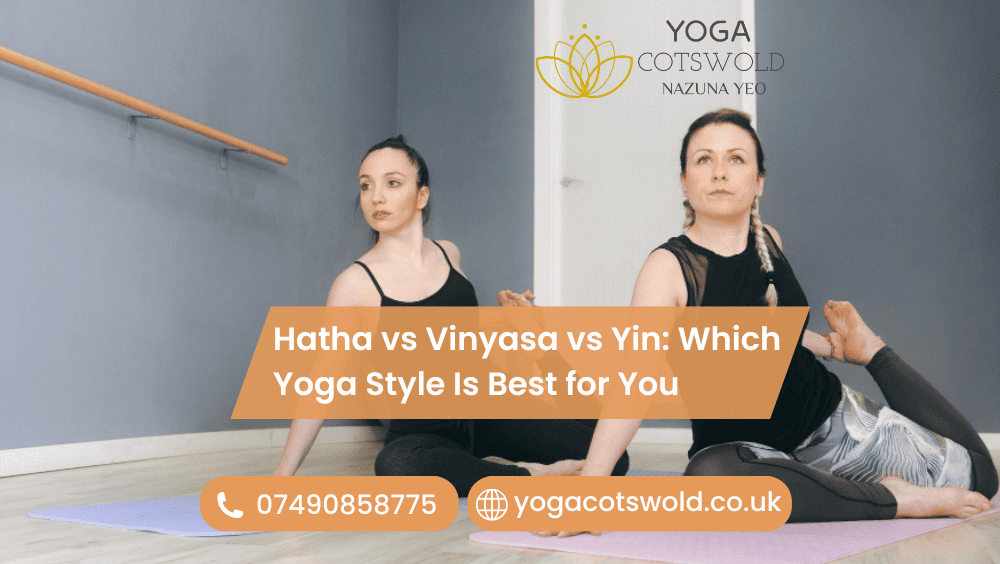
Your yoga class shouldn’t be the same as picking a mystery option from a menu. Still: If you’ve ever stared at a roster to figure out if Hatha, Vinyasa or Yin is the “right” class for your temperament or fitness level, you’re in good company. And each style can be exactly what you need — it just depends on your body, your mood, your day-to-day schedule and what you’re hoping to feel when you roll that mat back up.
At YOGA COTSWOLD, Nazuna Yeo says all the time yoga is not something you “win”. It’s something you return to. There are days when you need a firm foundation and straight alignment. Other days you need a little bit of sweat and flow to scrub the week away. And some nights, you just have to be still long enough that you can hear yourself breathing again.”
So, let’s make it simple. Here is how Hatha yoga, Vinyasa yoga and Yin yoga compare — and how to choose the style that’s right for you, not just one based on where a celebrity instructor goes.
What all three yoga styles share (and why it matters)
Even though these styles look and feel different, they usually share a few essentials:
Breath awareness (learning to breathe with intention, not by accident)
Asana practice (postures adapted for different bodies)
A focus on mind–body connection
A moment of rest at the end (sometimes long, sometimes short)
The true distinctions are pace (of course), intention and how much work you’re doing to hold yourself up, as opposed to letting gravity take over. That’s why one person can love Vinyasa and hate Yin, while another feels the exact opposite. Get details on Yoga Studio in Cheltenham.
Hatha Yoga: steady, clear, and quietly strong
If you seek relaxed, instructed entry into yoga — whether in order to reset your founding knowledge or fine-tune the same — Hatha usually is the most user-friendly place to start.
What it feels like
A Hatha yoga class tends to be slower-paced and more structured. You’ll establish a pose, hold it a few breaths, come out and move on. There’s time to see what your body is doing, instead of rushing on to the next posture.
Why people love it
It helps you learn alignment properly
It builds balanced strength and stability
It supports mobility and posture without a frantic pace
It feels grounding, especially when life is busy
Who it suits
Beginners who want a bit more guidance
People coming back after a break, illness, or injury
Anyone who wants yoga to feel steady and organised
When it might not be your favourite
If you’re craving a faster “workout” feeling, Hatha can seem slow. But slow doesn’t mean easy. Done with attention, it can be surprisingly challenging — in a focused, satisfying way. Looking for a Hatha yoga in Cheltenham?
Vinyasa Yoga: flowing movement that warms you up (fast)
The design that most people recognize is vinyasa yoga: movement paired with breath, sometimes in sequences designed to flow and create heat. It can be athletic, invigorating and mentally bracing — since you are too busy breathing to overthink everything.
What it feels like
In Vinyasa flow, you move from posture to posture with fewer pauses. Your breath is the “metronome”. Classes often include repeated transitions (like plank variations or downward dog), with sequences that change from week to week.
Why people love it
It builds strength (core, legs, shoulders) over time
It improves stamina and coordination
It can feel like a moving meditation
It’s a great mood-lifter when you feel stuck in your head
Who it suits
People who enjoy movement and variety
Anyone who wants yoga to feel energising and dynamic
Students who like creativity in a class structure
When it might not be ideal
Fast movement may feel like too much if you’re feeling tired, stressed out or are very stiff. If you’re new to yoga, Vinyasa will still be an option — but you’ll want a teacher who’s queuing modifications and delivering a pace that doesn’t feel like a race.
At YOGA COTSWOLD, the idea is never “keep up”. It’s “tune in”. Get details on Yoga Teacher in Pittville.
Yin Yoga: slow, deep, and surprisingly powerful
If your body feels tight from sitting, training, traveling or just being human, Yin yoga can seem like a reset button. It’s less frantic and a lot, well, quieter, but that doesn’t mean it can’t be intense in its own way — not because you’re moving so much as because you have to stay.
What it feels like
In a Yin yoga class, most of the poses are low to the ground and held for longer — around 2 to 5 minutes. You deploy props, relax muscles and let the body open organically. The room is often flooded with a calm, reflective feel.
Why people love it
It supports flexibility in hips, hamstrings, and lower back
It helps downshift the nervous system (especially after busy days)
It can improve sleep quality for many people
It teaches patience and body awareness in a real, practical way
Who it suits
Desk workers, runners, gym-goers — basically anyone who gets tight
People who want stress relief without “doing more”
Students who need calm, stillness, and recovery
When to practise carefully
If you’re naturally very bendy (hypermobility), Yin needs a gentle approach. Long holds can push you into your end range too easily. A good teacher will encourage props and a lighter sensation rather than a deep stretch.
Yin isn’t about “how far”. It’s about “how safe”. Looking for a Yoga Teacher in Leckhampton?
Hatha vs Vinyasa vs Yin: the simplest comparison
Here’s an easy way to remember the difference:
Hatha yoga → steady pace, alignment-focused, foundational
Vinyasa yoga → flowing pace, strength + heat, energising
Yin yoga → long holds, deep release, calming
And yes, you can love all three — just at different times in your life (or even different days of the week).
Which yoga style is best for you?
Rather than picking a style because someone else loves it, choose based on your goals and what your body is telling you.
Choose Hatha if you want…
A calmer pace with time to learn the basics
Better posture and alignment
A steady, balanced practice that doesn’t overwhelm
Choose Vinyasa if you want…
A stronger, more energetic session
Movement linked to breath
A class that helps you feel awake, warm, and focused
Choose Yin if you want…
Deep stretching and release, especially in hips and legs
Nervous system support and relaxation
A slower practice that helps you unwind and sleep better
What should you book today?
Here are some real-life match-ups that actually help:
You’ve been sitting all day and feel tight → start with Yin yoga
You feel anxious and need grounding → Hatha yoga or gentle Yin
You feel flat and sluggish → Vinyasa yoga (at a friendly pace)
You’re brand new to yoga → begin with Hatha, then explore Vinyasa
You train hard or run often → add Yin yoga for recovery
You want to improve technique and form → choose Hatha yoga
Also, it’s normal to change your mind. You’re allowed to. Your body is not a fixed schedule. Get details on Yoga Teacher in Prestbury.
A balanced weekly routine that works for most people
If you’re not sure where to start, a simple mix can be a game changer:
1–2 Vinyasa classes (strength + flow)
1 Hatha class (alignment + grounding)
1 Yin class (recovery + calm)
That combination keeps your practice supportive, not exhausting. Plus, it tends to reduce niggles, improve mobility, and help your mood feel a bit steadier — which is honestly a win.
What to expect at YOGA COTSWOLD with Nazuna Yeo
Nazuna’s method is pragmatic and generous: good alignment, breath-led movement and choices for real bodies. You will not be squashed into shapes that don’t fit you and you won’t be made to feel “behind”.
Expect:
Clear cues and sensible modifications
Encouragement to use props (no awkwardness)
A calm pace that still feels purposeful
A friendly class vibe where you can simply practise
Because yoga isn’t meant to add pressure. It’s meant to remove it.
Related Articles:
» Yoga for Chronic Pain and Inflammation
» 30-Day Yoga Tone-Up Challenge
» Morning Yoga for Beginners: 10-Minute Wake-Up Flow
» Yoga for Scoliosis: Gentle Poses to Even Out Tension
» Starting Yoga Again After a Break: A Gentle 4-Week Plan
Finding the Yoga Style That Fits You
If you want steady foundations, choose Hatha yoga. If you want energy and flow, choose Vinyasa yoga. If you want deep release and calm, choose Yin yoga. And if you want the best long-term approach? Rotate them. Life changes — and your yoga can change with it.
FAQs on "YOGA Hatha vs Vinyasa vs Yin"
1) Which yoga style is best for beginners?
For most beginners, Hatha yoga feels safer because it’s slower and alignment is clearly taught.
2) Is Vinyasa yoga harder than Hatha?
Often yes, because Vinyasa flows continuously. Still, class level matters — some Vinyasa classes are gentle and accessible.
3) Will Yin yoga make me more flexible?
This can be beneficial over the long term, particularly for hips and hamstrings, since the holds are longer and more gradually increase.
4) Is Yin yoga OK if I’m not flexible at all?
Yes. Use props and stay at a mild sensation. You don’t need to “reach” anything — you just need to breathe.
5) Which style is best for stress?
Yin yoga and Hatha yoga are both generally very chill. If moving tends to settle your mind, vinyasa might help.
6) Can Vinyasa yoga help with fitness?
Yes. Vinyasa yoga can tone and strengthen the body, and it tends to feel more like a workout.
7) How many times a week should I do yoga?
A good start is 2–3 times per week. Even one day a week is beneficial, but consistency is what makes the difference.
8) Which style is best for back pain?
It depends on the cause. For many, the alignment of Hatha and the gentle releasing practice of Yin can be a wonderful combination under proper guidance.
9) Is Yin yoga safe for hypermobile people?
It can be, but you should practise conservatively and avoid deep end-range stretching. Support with props and focus on stability.
10) Which style helps posture most?
Hatha yoga is great for posture because it helps to create awareness, strength and alignment.
Contact
info@yogacotswold.co.uk
Social Media
Get in Touch
07490858775

Address: GEORGE MOORE COMMUNITY CENTRE- BOURTON ON THE WATER
Moore Road, Bourton on the Water GL54 2AZ